
Idotea urotoma
Stimpson, 1864
blunt-tailed isopod
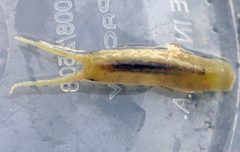
Idotea urotoma, the blunt-tailed isopod, is a marine isopod inhabiting low intertidal and shallow subtidal zones along the northeastern Pacific coast. It exhibits color that matches its algal or seagrass substrate, providing camouflage. The species is distinguished by a broadly triangular margin lacking a distinct projection.
Pronunciation
How to pronounce Idotea urotoma: /ˌaɪ.doʊˈtiː.ə juːˈroʊ.toʊ.mə/
These audio files are automatically generated. While they are not always 100% accurate, they are a good starting point.
Identification
The blunt-tailed isopod is reliably distinguished from other Idotea by its : the margin is broadly triangular with converging sides and no distinct projection. Additionally, I. urotoma shares with I. rufescens and I. ochotensis the diagnostic trait of a four-articled maxilliped palp, whereas most Idotea species possess five articles.
Images
Habitat
Low intertidal and shallow subtidal zones. Found on seaweed and seagrass substrates.
Distribution
Northeastern Pacific: Puget Sound, Washington (USA) to Baja California (Mexico).
Life Cycle
Gonochoric (separate sexes). Mating has been observed to occur before and sometimes during molting.
Similar Taxa
- Idotea rufescensShares the four-articled maxilliped palp trait, but differs in and geographic distribution
- Idotea ochotensisShares the four-articled maxilliped palp trait, but differs in and geographic distribution
- Other Idotea speciesMost possess five-articled maxilliped palps and distinct projection on
More Details
Color polymorphism
Coloration is substrate-dependent, ranging from yellowish gold to reddish brown to black, providing camouflage against seaweed and seagrass.