
Chaetiliidae
Dana, 1849
Genus Guides
2- Chiridotea(Sandmoles)
- Saduria
Chaetiliidae is a of marine isopod crustaceans in the suborder Valvifera. The family includes approximately 12 , ranging from small estuarine to the Antarctic giant isopod Glyptonotus antarcticus. Members occupy diverse from shallow coastal waters to deep Antarctic seas. Some species exhibit complex with maternal care and sibling .
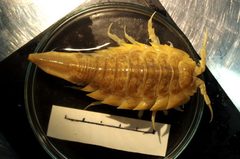
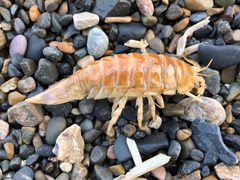
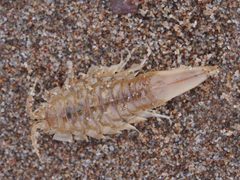
Pronunciation
How to pronounce Chaetiliidae: //kaɪˈtɪl.i.aɪdiː//
These audio files are automatically generated. While they are not always 100% accurate, they are a good starting point.
Images
Habitat
Marine and estuarine environments. Saduriella losadai occurs in river estuaries at the mesohaline-oligohaline boundary, preferring sandy sediments. Glyptonotus antarcticus inhabits Antarctic marine environments.
Distribution
Widespread in marine environments. Saduriella losadai recorded from Minho River estuary, northwestern Iberian Peninsula. Glyptonotus antarcticus recorded from Antarctica, including Signy Island and South Orkney Islands. Distribution records from Denmark and Norway (GBIF).
Seasonality
Saduriella losadai shows recruitment peaks in spring-summer. Juvenile to freshwater occur in late spring and summer; migrations to lower estuary occur in autumn. Mature migrate back in winter before reproductive season.
Life Cycle
Glyptonotus antarcticus exhibits prolonged incubation with slow development. Marsupial occurs in a modified pouch. Developing young receive nutrition via adelphophagy (sibling ) and maternal secretion. Saduriella losadai shows two recruitment peaks annually.
Behavior
Saduriella losadai uses tidal drift during flood tides for . Juveniles migrate to freshwater environments and back to lower estuary seasonally. Glyptonotus antarcticus exhibits adelphophagy during incubation as a nutritional strategy.
More Details
Brood pouch morphology
Glyptonotus antarcticus possesses a marsupium with characteristics deviating from the typical Idotea-type marine isopod pouch, with some features resembling the Porcellio-type of terrestrial isopods.
Population trends
Saduriella losadai showed a sharp decline in abundance in the Minho River estuary compared with data from 40 years prior, though further study is needed to confirm this trend.
Epizoic associations
Two unidentified epizoic (a turbellarian flatworm and a fish leech) have been observed on Glyptonotus antarcticus in the vicinity of the marsupium.
Sources and further reading
- BugGuide
- Wikipedia
- GBIF taxonomy match
- iNaturalist taxon
- NCBI Taxonomy
- Catalogue of Life
- Marsupium morphology and brooding biology of the Antarctic giant isopod, Glyptonotus antarcticus Eights 1853 (Crustacea, Isopoda, Chaetiliidae)
- Notes on the occurrence and ecology of Saduriella losadai (Isopoda: Chaetiliidae) in the Minho River estuary (NW Iberian Peninsula)