
Cirolanidae
Dana, 1852
Genus Guides
4- Bathynomus(Giant Isopods)
- Cirolana
- Cirolanides
- Excirolana
Cirolanidae is a of aquatic isopod crustaceans established by Dana in 1852. The family encompasses approximately 70 and over 500 , ranging from small forms to the supergiant deep-sea isopods of the genus Bathynomus that can exceed 30 cm in length. Members occupy diverse aquatic including marine coastal waters, deep-sea environments, freshwater systems, and subterranean groundwater. The family is characterized by dorsoventrally flattened bodies and includes both free-living and troglobitic species.
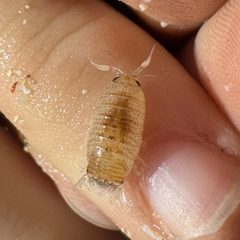
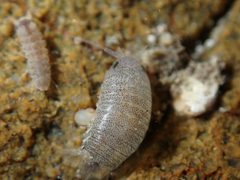
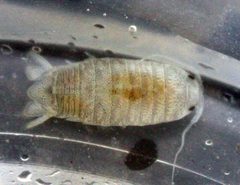
Pronunciation
How to pronounce Cirolanidae: /ˌsaɪrəˈlænəˌdiː/
These audio files are automatically generated. While they are not always 100% accurate, they are a good starting point.
Identification
Cirolanidae can be distinguished from other cymothoidan by the combination of: dorsoventrally flattened body form; uropods inserted terminally or subterminally on the pleotelson; pleon with five free pleonites plus the pleotelson; and antennule peduncle of three articles. They differ from cymothoid fish in lacking and from sphaeromatid isopods in having a non-vaulted pleon. Troglobitic often show convergent adaptations including elongated appendages, reduced or absent , and pale coloration. The supergiant Bathynomus is immediately recognizable by its large size (exceeding 10 cm), heavily calcified , and distinctive cephalic structure.
Images
Appearance
Cirolanids exhibit dorsoventrally flattened bodies typical of flabelliferan isopods. Body size ranges from minute forms under 5 mm to supergiant exceeding 30 cm in length. The body is divided into a with segments and a pereon with seven pairs of legs. Most species possess , though these are reduced or absent in troglobitic (cave-dwelling) species. The pleotelson is formed by fusion of the sixth pleonite and . Uropods are typically well-developed and variable in form, ranging from short and broad to elongate and styliform. are biramous, with the inner often reduced. The bear a mobilis, a characteristic isopod feature.
Habitat
Cirolanids occupy diverse aquatic environments across the full spectrum of salinity and depth. Marine inhabit coastal waters from the intertidal zone to the deep sea, including coral reefs, sandy beaches, rocky substrates, and soft sediments. The includes notable deep-sea components, with Bathynomus species occurring at bathyal and abyssal depths. Freshwater and brackish water representatives occur in groundwater, caves, and , particularly in the Mediterranean region and Caribbean. Subterranean species are restricted to anchialine caves, limestone karst systems, and interstitial spaces in marine and freshwater sediments. Some species show euryhaline , capable of surviving across wide salinity ranges.
Distribution
distribution across world oceans from polar to tropical regions. Marine coastal occur in the Atlantic, Pacific, and Indian Oceans. The Mediterranean Sea harbors significant freshwater and brackish groundwater diversity, particularly in the Turcolana. Caribbean islands support multiple stygobiont genera including Arubolana, Bahalana, and Speocirolana. Indo-Pacific regions contain the highest diversity of coral reef-associated species. Deep-sea Bathynomus species occur globally in bathyal and abyssal zones. Records from the Miocene of Italy document fossil occurrences in the paleo-Mediterranean.
Diet
Predominantly and scavenging. Natatolana borealis has been documented as an active scavenger consuming carrion in marine environments. Bathynomus are known to scavenge on whale falls and other deep-sea organic deposits. Some coastal species are predatory on small . Specific dietary data for most species remains unstudied.
Life Cycle
Development is direct with no larval stages; young hatch as mancae (post-larvae resembling miniature ). Ovigerous females carry in a pouch formed by oostegites. Bathynomus doederleini has been studied for reproductive , with females producing multiple broods. Mancae undergo gradual growth through successive , with no . times vary from in small to potentially multi-year in large deep-sea forms.
Behavior
Many are nocturnally active, seeking shelter under rocks or in sediments during daylight. Sand beach species exhibit tidal rhythms of activity. Deep-sea Bathynomus species are benthic walkers, using their robust legs to traverse soft sediments. Some species show aggregative at food falls. Troglobitic species display reduced activity levels and slow movement consistent with energy-limited cave environments.
Ecological Role
Scavengers and in marine benthic . Deep-sea contribute to whale fall and wood fall , processing large organic inputs to the seafloor. Intertidal and shallow-water species function as predators and carrion consumers. Subterranean species occupy apex predator positions in chemoautotrophically-supported cave . Some species serve as prey for larger benthic predators including fish and decapod crustaceans.
Human Relevance
Bathynomus have become commercially fished as seafood in Vietnam, where they are marketed as "bọ biển" (sea ) and command premium prices comparable to lobster. This fishery has expanded since 2017, with specimens sold live in markets in Hanoi, Ho Chi Minh City, and Da Nang. The discovery of Bathynomus vaderi from seafood markets highlights the potential for cryptic species in exploited . No other direct human uses are documented. Some species may incidentally affect aquaculture operations through .
Similar Taxa
- CymothoidaeFish-parasitic isopods with similar body plan; distinguished by adapted for and parasitic lifestyle on fish
- SphaeromatidaeCoastal marine isopods with dorsoventrally flattened bodies; distinguished by vaulted pleon that can be enrolled into a ball, and different uropod structure
- CorallanidaeFreshwater and marine isopods with similar ; distinguished by details of mouthpart structure and uropod
More Details
Subterranean diversity
Cirolanidae contains exceptional diversity of stygobiont (groundwater-restricted) , with of troglomorphic traits across multiple . Six genera with nine stygobiont species are known from seven Caribbean islands, and the Mediterranean region harbors numerous cave-adapted species in the genus Turcolana. These represent independent colonizations of subterranean .
Size evolution
The exhibits the most extreme body size range within Isopoda, from 2 mm to Bathynomus supergiants exceeding 500 mm and 2.6 kg. This gigantism in deep-sea species is among the most pronounced examples of deep-sea size increase (abyssal gigantism) documented in marine .
Taxonomic activity
The has been subject to intensive taxonomic research, with numerous new described in recent decades. The Bathynomus received particular attention following the description of B. vaderi from Vietnam in 2025, which was subsequently recognized as senior synonym of B. paracelensis described later the same year.
Sources and further reading
- BugGuide
- Wikipedia
- GBIF taxonomy match
- iNaturalist taxon
- NCBI Taxonomy
- Catalogue of Life
- The Sith Lord of the Sea: Supergiant Isopod in the WoRMS’ Top 10 Marine Species of 2025 | Blog
- New giant sea bug species named after Darth Vader
- Spider megacolony study breaks publicity records at Pensoft
- Arubolana Parvioculata n. sp. (Isopoda, Cirolanidae)
- Eurydice Mauritanica, New Species (Isopoda: Flabellifera: Cirolanidae), from Western Africa, with Distribution and List of Species of Cirolanidae Known from the Region
- New Species of the Cirolana "parva-group" (Crustacea: Isopoda: Cirolanidae) from Coastal Habitats Around New Zealand
- Biology of feeding in the scavenging isopodNatatolana borealis(Isopoda: Cirolanidae)
- Cirolanidae (Isopoda) From French Polynesian Coral Reefs: Description of Three New Species
- Development, Reproduction and Nutrition of the Giant Isopod Ba Thynomus Doederleini Ortmann, 1894 (Isopoda, Flabellifera, Cirolanidae)
- Palaega picena n. sp. (Crustacea, Isopoda, Cirolanidae) from the Miocene of Arcevia, Ancona (Marche, Central Italy)
- The first Turcolana Argano & Pesce, 1980 (Isopoda: Cirolanidae) from the Greek mainland
- The Systematics and Ecology of Some Sand Beach Isopods (Family Cirolanidae) From the Coasts of Saudi Arabia
- Bathynomus vaderi Ng, Sidabalok & Nguyen, 2025: the senior synonym of B. paracelensis Huang & Kawai, 2025 (Crustacea, Isopoda, Cirolanidae).
- A new species of supergiant Bathynomus A. Milne-Edwards, 1879 (Isopoda: Cirolanidae) from the Paracel Islands, South China Sea.