
Megalorchestia corniculata
(Stout, 1913)
beach hopper
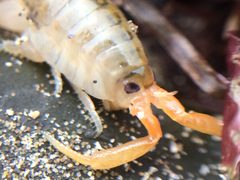
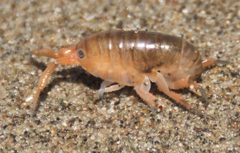
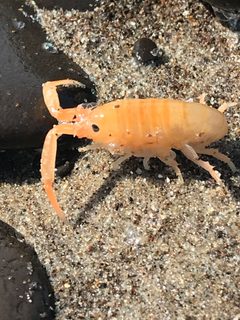
Megalorchestia corniculata is a beach-dwelling amphipod in the Talitridae, commonly known as a beach hopper. It inhabits sandy intertidal zones along the Pacific coast of North America. The plays a significant ecological role as a consumer of marine wrack, contributing to nutrient cycling in coastal .
Pronunciation
How to pronounce Megalorchestia corniculata: //ˌmɛɡəˌlɔːrˈkɛstiə kɔːrnɪˈkjʊlətə//
These audio files are automatically generated. While they are not always 100% accurate, they are a good starting point.
Identification
Distinguished from other beach hoppers by its robust body form and the characteristic horn-like (corniculate) projections on the urosome segments, which give the its name. Males typically possess larger and more developed than females. The species is larger than many sympatric talitrids, reaching approximately 25-30 mm in body length.
Images
Habitat
Sandy ocean beaches in the supralittoral and upper intertidal zones. Found in moist sand beneath and around washed-up seaweed (wrack), driftwood, and other organic debris. Requires humid microhabitats to avoid desiccation during daytime.
Distribution
Pacific coast of North America, from Alaska to southern California, United States. Records indicate presence in coastal areas of the contiguous western United States.
Seasonality
Active year-round in temperate coastal regions, with peak surface activity during nighttime hours and following high tides when wrack deposits are fresh. Activity decreases during extreme cold or hot conditions.
Diet
Primarily consumes marine macroalgae (seaweed), particularly kelp and other brown washed ashore as wrack. Feeding has been observed on decomposing organic matter in beach strandlines.
Behavior
Nocturnally active, emerging from burrows in moist sand to feed on surface wrack. Capable of rapid, saltatory locomotion (hopping) using the uropods and pleopods to escape and desiccation. Aggregates in large numbers around fresh wrack deposits.
Ecological Role
Critical consumer of wrack in sandy beach . By consuming washed-up seaweed and excreting ammonium, it accelerates decomposition and enhances nutrient availability in nutrient-poor sandy substrates. This nutrient cycling supports primary productivity and in intertidal environments.
Human Relevance
Serves as an for healthy sandy beach . Occasionally encountered by beachgoers at night. No direct economic importance, but contributes to ecosystem services through nutrient cycling and as prey for shorebirds and other coastal .
Similar Taxa
- Megalorchestia californianaLarger congeneric with which it may co-occur; distinguished by greater body size (up to 33 mm) and different urosome
- Transorchestia spp.Smaller sympatric beach hoppers lacking the prominent cornuculate projections on urosome segments
- Orchestoidea spp.Related beach hoppers with similar habits but differing in body proportions and urosome structure
More Details
Etymology
The specific epithet 'corniculata' refers to the small horn-like projections on the urosome segments, a diagnostic morphological feature of this .
Taxonomic History
Originally described as Orchestoidea corniculata by Stout in 1913, later transferred to Megalorchestia based on revised generic concepts within Talitridae.