
Petrolisthes armatus
(Gibbes, 1850)
Green Porcelain Crab
Petrolisthes armatus, commonly known as the green porcelain crab, is a small porcellanid crab native to the southwestern Atlantic, particularly Brazil. The has established along the southeastern United States coast, where densities can exceed 30,000 individuals per square meter. Genetic studies confirm it as a single monophyletic species with exceptional geographic range spanning the Atlantic and eastern Pacific. It is frequently parasitized by the bopyrid isopod Aporobopyrus curtatus, which causes .
Pronunciation
How to pronounce Petrolisthes armatus: //ˌpɛt.rəˈlɪs.θiːz ɑːrˈmɑː.təs//
These audio files are automatically generated. While they are not always 100% accurate, they are a good starting point.
Identification
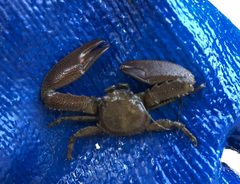
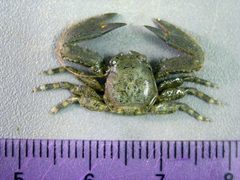
Small crab with oval, granulated bearing shallow narrow ridges and bluntly pointed front. Two long chelipeds with distinctive orange spot on chelae visible when parted. Chelipeds composed of four segments rather than five. Three pairs of legs plus fourth pair. with spine on first segment, positioned outside stalked (diagnostic for porcelain crabs, contrasting with true crabs where antennae are between eyes). Body length 6–8 mm, weight approximately 0.5 g. Color generally brown or dark olive-green; juveniles paler and mottled. Mouthparts sometimes bright blue; entire animal occasionally bright blue.
Images
Habitat
Lower intertidal zone to shallow subtidal zone. Found on rock rubble, oyster beds, soft sediments, and mangrove . in southeastern United States particularly abundant on oyster reefs and intertidal hard substrates.
Distribution
Native range: southwestern Atlantic, believed to be Brazil. Established : southeastern United States (Florida, Georgia, South Carolina), tropical west Africa, Ascension Island, Bermuda, Bahamas, Caribbean Sea, Gulf of Mexico, West Indies, tropical Atlantic coast of South America. Eastern Pacific: Baja California to Peru, including Panama (present since 1859, pre-dating Panama Canal).
Diet
Primarily a , using large feathery mouthparts to capture zooplankton. Also scavenges on animal remains on the seabed. Has been observed forming symbiotic relationships with sponges, positioning itself to intercept food particles from the sponge's water current.
Host Associations
- Aporobopyrus curtatus - Bopyrid isopod parasitizing branchial chamber; causes ; up to 17% with up to six isopods per ; negative correlation between size and host size suggests impaired host growth
Life Cycle
Females store until mature, then retain fertilized eggs under tail flap aerated by pleopods until hatching. Larvae are planktonic with two zoeal stages and one megalopal stage. Larval settlement possibly cued by from other . Females may reach sexual maturity at 3 mm body length. Vertical larval movement plays significant role in estuarine transport and retention.
Behavior
Uses achromatic visual cues for gaze stabilization; does not use angle of linearly polarized light for this purpose. When symbiotic with sponges, positions body to exploit 's water current for feeding.
Ecological Role
and scavenger in intertidal and shallow subtidal . in southeastern United States compete with native and may impact shellfish production on oyster beds. High densities alter local community structure. - dynamics with Aporobopyrus curtatus affect population structure through .
Human Relevance
Considered in southeastern United States due to dramatic increases and competition with native fauna. Concern regarding impacts on oyster bed shellfish production. Likely spread via ballast water transport of larvae and aquaculture seeding of shellfish beds.
Sources and further reading
- BugGuide
- Wikipedia
- GBIF taxonomy match
- iNaturalist taxon
- NCBI Taxonomy
- Catalogue of Life
- Europe’s most complete stegosaurian skull unearthed in Spain
- Naturalists can mediate silent plankton invasions | Blog
- Bug Eric: Anteater Scarab Beetles
- Distribution and retention of Petrolisthes armatus in a coastal plain estuary: The role of vertical movement in larval transport
- Population relationships between the parasiteAporobopyrus curtatus(Richardson, 1904) (Isopoda: Bopyridae) and one of its porcelain crab hostsPetrolisthes armatus(Gibbes, 1850) (Decapoda: Porcellanidae) from Farol Island, southern Brazil
- Insights of the life history in the porcellanid crab Petrolisthes armatus (Gibbes, 1850) (Crustacea: Anomura: Porcellanidae) from the Southwestern Atlantic coast
- Two Decapod Crustaceans, Panopeus herbstii and Petrolisthes armatus, Stabilize Their Gaze Using Achromatic Visual Cues, but Not the Angle of Linearly Polarized Light