
Petrolisthes
Stimpson, 1858
porcelain crabs
Species Guides
2- Petrolisthes armatus(Green Porcelain Crab)
- Petrolisthes eriomerus(flattop crab)
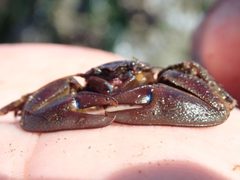
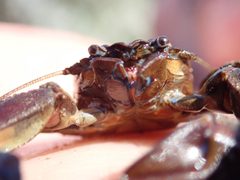
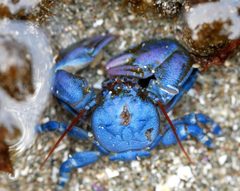
Petrolisthes is a of marine porcelain crabs in the Porcellanidae, containing approximately 50 extant distributed across temperate and tropical coastal regions of the Pacific Rim and warm Western Atlantic. These small, flattened crabs occupy intertidal and subtidal zones, often forming dense under rocks and within crevices. Multiple species have been subject to intensive behavioral and ecological study, revealing complex patterns of , thermal , and settlement . Two species (P. cinctipes and P. manimaculis) have been sequenced, providing genomic resources for studying physiological responses to climate change.
Pronunciation
How to pronounce Petrolisthes: /pɛtrəˈlɪsθiːz/
These audio files are automatically generated. While they are not always 100% accurate, they are a good starting point.
Images
Habitat
Shallow coastal of temperate and tropical Pacific Rim and warm Western Atlantic; intertidal and subtidal zones. Cobblestone beaches and boulder fields provide preferred microhabitat, where crabs aggregate in high densities beneath rocks and within crevices. Cobble size is a strong predictor of and mean body size, indicating its importance as a quality indicator through its relationship to availability and size of shelter spaces.
Distribution
Eastern Pacific: approximately 50 distributed across four principal regions (north temperate, northern Gulf of California, tropics, south temperate). Specific documented locations include New Zealand, Tasmania, and northeastern Pacific (California, USA). West Atlantic species occur in Caribbean Sea and adjacent regions.
Diet
Filter feeding.
Life Cycle
Biphasic lifecycle with planktonic larval stage and benthic stage. Larvae respond to waterborne settlement cues released by adults, with settlement rates 4-fold higher in the presence of adults. Recently metamorphosed individuals may continue responding to conspecific cues, presumably facilitating with adults that provide protection from and desiccation.
Behavior
Forms dense in shelter-limited . Exhibits complex behavioral competition for shelter spaces, with outcomes influenced by body size, sex, reproductive status, and status. Smaller individuals generally spend more time in shelter and initiate fewer competitive interactions; larger individuals more successfully displace smaller ones from shelters. Males engage in more shoving interactions than females. Ovigerous females and autotomized males spend significantly more time under shelter and show distinct competitive . Agonistic interactions involve antennal taps and chela shoves, with limited forceful contact; these exchanges may serve exploratory and social bonding functions to maintain aggregations. Mobility is limited, with most individuals moving less than 100 cm over 25 hours; local and are primary drivers of limited mobility.
Human Relevance
assemblies of P. cinctipes and P. manimaculis provide model systems for studying physiological responses to climate change and fine- genome evolution in decapod crustaceans.
Sources and further reading
- BugGuide
- Wikipedia
- GBIF taxonomy match
- iNaturalist taxon
- NCBI Taxonomy
- Catalogue of Life
- Genome assemblies of two species of porcelain crab, Petrolisthes cinctipes and Petrolisthes manimaculis (Anomura: Porcellanidae)
- Behavioural Competition in the Intertidal Shore Crab, Petrolisthes elongatus
- Agonistic Interactions of the Crab Petrolisthes (Crustacea, Anomura)
- Spatial Dynamics and Life History Characteristics of an Aggregating Species, Petrolisthes Elongatus
- Description of a new species of the Petrolisthes galathinus complex from the Caribbean Sea, and resurrection of Petrolisthes occidentalis from the East Pacific (Crustacea, Anomura, Porcellanidae)
- How seasonal thermal variation within the intertidal zone and body condition affects the thermal escape behavior of Petrolisthes cinctipes
- Evolutionary Aspects of Communication in the Courtship Behavior of Four Species of Anomuran Crabs (Petrolisthes)