
Triops longicaudatus
(LeConte, 1846)
Longtail Tadpole Shrimp, American Tadpole Shrimp, Rice Tadpole Shrimp
Triops longicaudatus is a freshwater branchiopod crustacean commonly known as the longtail tadpole shrimp or rice tadpole shrimp. It inhabits ephemeral ponds and pools across western North America, South America, Japan, South Korea, and Pacific Islands. The is notable for its ancient lineage—morphologically unchanged for over 170 million years—and its remarkable desiccation- that can survive decades in dry sediment before hatching upon rehydration. It displays multiple reproductive strategies including , hermaphroditism, and . In California agriculture, it is a significant early-season pest of rice, damaging germinating seeds in flooded fields.
Pronunciation
How to pronounce Triops longicaudatus: //ˈtraɪ.ɒps ˌlɒŋ.gɪ.kɔːˈdeɪ.təs//
These audio files are automatically generated. While they are not always 100% accurate, they are a good starting point.
Identification
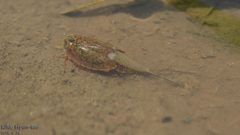
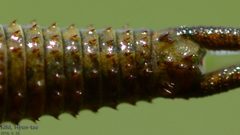
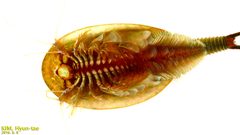
The combination of three (two plus ocellus), shield-like covering most of the , extremely long tail filaments nearly equal to body length, and uniform brownish coloration distinguishes T. longicaudatus from other notostracans. The absence of second and presence of only maxillules is a key anatomical feature. In rice fields, murky chocolate-brown water caused by their bottom-feeding and burrowing activity is a diagnostic indicator of their presence.
Images
Habitat
Freshwater ephemeral ponds, pools, and temporary water bodies that undergo periodic drying. In agricultural settings, inhabits flooded rice fields. Often found in environments where few higher life forms can survive due to harsh or fluctuating conditions.
Distribution
Western North America (Canada: Alberta, Saskatchewan, Manitoba; contiguous United States, Mexico, Hawaii), South America (Argentina, Galápagos Islands), West Indies, Pacific Islands including Japan, South Korea, New Caledonia, and Mongolia. Most widespread notostracan .
Seasonality
Active during winter and spring when pools fill with rainwater; hatch upon flooding. die as pools dry up in summer and autumn. In rice systems, emerges as early-season pest soon after field flooding. Life span 20–90 days if water persists.
Diet
. Feeds on , plant material, insects, other organic debris, and small including fairy shrimp, very small fish fry, tadpoles, and oligochaete worms. observed, particularly at higher temperatures. Filter-feeds as larvae; predatory as juveniles and .
Life Cycle
in survive desiccation for up to 20 years, requiring complete drying before successful rehydration and hatching. Upon flooding, metanauplius larvae hatch within 1–3 days, orange in color with single and six legs. Develops through multiple instars, increasing segments and appendages, transitioning to greyish-brown. Reaches sexual maturity in approximately 8 days at 30°C. produce desiccation- cysts carried in pouches (modified eleventh legs in females) for several hours before release in batches; eggs deposited in shallow burrowed chambers in substrate.
Behavior
Intense locomotor activity including swimming (often upside down at surface) and digging. Bottom-dwelling, scratching mud while searching for benthic food. Burrows shallow chambers in substrate for deposition. Stirring sediments during feeding creates characteristic murky water. Cannibalistic reduced at lower temperatures (23°C) likely due to metabolic slowdown. Filter-feeding in larval stages transitions to predatory behavior in juveniles and .
Ecological Role
Human Relevance
Agricultural pest in California rice fields, managed primarily with though using mosquitofish (Gambusia affinis) is being evaluated. Sold commercially as aquarium pets under names including 'aquasaurs,' 'trigons,' or 'triops' in dried kits. Used as model organism in ecotoxicology research due to fast development, short , and sensitive behavioral endpoints. for environmental monitoring of freshwater .
Similar Taxa
- Triops cancriformisDistinguished by yellow with dark spots versus uniform brownish carapace; both share ancient lineage and similar body plan
- Lepidurus packardiEndangered California vernal pool with different shape and specificity; T. longicaudatus is abundant and widespread in contrast
- Fairy shrimp (Anostraca)Superficially similar in ephemeral pool but lack shield-like and have distinctly different body form with fewer appendages
Misconceptions
Neither a tadpole nor a shrimp; commonly misnamed due to superficial resemblance to frog tadpoles. Is a crustacean, not an insect or true shrimp. The 'living fossil' status refers to morphological stasis, not unchanged genetics or .
More Details
Reproductive plasticity
One of only two Triops displaying three reproductive strategies: bisexual, unisexual (parthenogenetic), and hermaphroditic. Most are highly male- or female-biased with most common.
Physiological adaptation
Exhibits developmental plasticity in hemoglobin subunit expression in response to hypoxia, with differential expression of four primary subunits (30–34 kDa) depending on oxygen availability. Unlike Daphnia and Artemia, this hypoxic response is not reversible upon return to normoxic conditions.
Agricultural management
Research ongoing to reduce reliance through alternative strategies including cultural practices, reduced-rate applications, and using mosquitofish.
Sources and further reading
- BugGuide
- Wikipedia
- GBIF taxonomy match
- iNaturalist taxon
- NCBI Taxonomy
- Catalogue of Life
- Ten Facts You May Not Know About Tadpole Shrimp | Bug Squad
- Begone Tadpole Shrimps! They're 'Time Travelers' in Rice Fields | Bug Squad
- Outstanding Group of UC Davis Graduate Students at ESA Meeting | Bug Squad
- Visitors Marvel at Tadpole Shrimp at Bohart Museum Open House | Bug Squad
- Have a Rice Day! (Except for the Armyworms) | Bug Squad
- Why Phoenix Is the Place to Be Nov. 10-13 | Bug Squad
- Ecotoxicological Effects of Potassium Dichromate on the Tadpole Shrimp Triops longicaudatus
- Toxic Relationships: Prediction of TBT’s Affinity to the Ecdysteroid Receptor of Triops longicaudatus
- Developing a monitoring protocol using geostatistical Kriging to characterize the spatial distribution of tadpole shrimp (Triops longicaudatus) in California rice fields
- Environmental hypoxia influences hemoglobin subunit composition in the branchiopod crustaceanTriops longicaudatus