
Branchinecta
Verrill, 1869
fairy shrimp
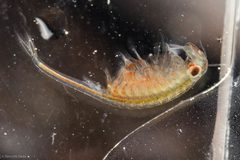
Branchinecta is a of fairy shrimp (Anostraca) comprising approximately 50 distributed across all continents except Australia. The genus includes the largest anostracan, Branchinecta gigas, reaching up to 10 cm in length, and the highest-altitude crustacean, B. brushi, recorded at 5,930 m elevation. Species occupy diverse temporary freshwater from Arctic and Antarctic regions to high-elevation Andean pools. Two species, B. gaini and B. granulosa, have been synonymized based on molecular evidence showing insufficient genetic differentiation.
Pronunciation
How to pronounce Branchinecta: /bræŋkaɪˈnɛktə/
These audio files are automatically generated. While they are not always 100% accurate, they are a good starting point.
Identification
identification relies heavily on male second , including the presence, arrangement, and form of spines, bulges, and lobiform projections on antennomeres. Female characters include pouch structure, thoracic ornamentation (rough , spines), and abdominal segment features such as lateral crenulations. Geographic distribution provides supporting evidence. Molecular markers (COI, 16S, ITS2) increasingly used to resolve cryptic diversity and phylogenetic relationships.
Images
Habitat
Temporary freshwater including vernal pools, seasonal ponds, shallow astatic pools, and meltwater ponds. Occupies extreme environments from Antarctic freshwater bodies to high-elevation Andean pools above 3,700 m and alkaline wetlands. Many adapted to cold or seasonally cold conditions; some specifically winter-active.
Distribution
excluding Australia. Documented from North America (including Arctic regions), South America (Patagonia, Andes, Brazil, Uruguay), Europe, Asia, Africa, and Antarctica. Notable records: B. gaini/B. granulosa in Maritime Antarctica; B. brushi at 5,930 m in the Andes; B. paludosa with circumpolar distribution.
Seasonality
Activity patterns tied to temporary pool hydroperiods. Some winter-active (e.g., B. hiberna); most emerge with seasonal thaw or precipitation events. In Antarctic , activity limited to austral summer when meltwater ponds form.
Life Cycle
Typical anostracan development: hatch into nauplius larvae, progressing through metanaupliar stages to and forms. Resting eggs (cysts) produced, allowing persistence through dry periods. Specific developmental rates and stage durations vary by and environmental conditions.
Behavior
Swimming occurs via metachronal beating of thoracic appendages. Some exhibit sophisticated food manipulation: B. gaini uses abdominal appendages to 'scrape' and transport food items, employing this for both detrital feeding and of dead conspecifics.
Ecological Role
Important consumers in temporary freshwater . B. gaini contributes to nutrient cycling through detrital processing and carcass scavenging. Serves as prey for aquatic where present. In Antarctic ecosystems, represents a significant component of freshwater as the largest invertebrate in these .
Human Relevance
Some of conservation concern due to vernal pool loss (e.g., B. lynchi, B. conservatio in North America). Subject of biogeographic and phylogenetic research. Extreme-altitude and Antarctic species of interest for understanding physiological adaptations to harsh environments.
Similar Taxa
- Archaebranchinecta established in 2011 for two previously placed in Branchinecta; distinguished by plesiomorphic morphological features
- ArtemiaAlso anostracan but in Artemiidae; distinguished by highly saline preference and different antennal and limb
- Streptocephalus Streptocephalidae; males distinguished by distinctive 'crown' or forceps-like second structure rather than the varied antennal forms seen in Branchinecta
More Details
Taxonomic Revision
B. gaini, long considered to Antarctica, has been synonymized with the Patagonian B. granulosa based on molecular evidence of insufficient genetic differentiation and Pleistocene divergence timing.
Extreme Environments
The exhibits exceptional environmental , including the highest crustacean altitude record (B. brushi, 5,930 m) and the southernmost anostracan distribution (B. granulosa/gaini in Maritime Antarctica).
Feeding Ecology Diversity
Feeding strategies range across the : some appear to be primarily detritivorous/filter-feeders, others facultatively (B. gigas, B. ferox, B. raptor), with B. gaini occupying an intermediate position with flexible omnivory including .
Sources and further reading
- BugGuide
- Wikipedia
- GBIF taxonomy match
- iNaturalist taxon
- NCBI Taxonomy
- Catalogue of Life
- A new species of Branchinecta (Crustacea: Anostraca) from Brasil
- Feeding behaviour in the Antarctic fairy shrimp, Branchinecta gaini
- A new species of Branchinecta (Crustacea: Anostraca) from Uruguay
- A new fairy shrimp, Branchinecta piurae sp. nov. (Branchiopoda: Anostraca), from Peru
- Life History and Energy Relations of the Giant Fairy Shrimp Branchinecta gigas Lynch 1937 (Crustacea: Anostraca)
- South! Phylogeography of the Antarctic fairy shrimp Branchinecta gaini and its closest Patagonian congener Branchinecta granulosa reveals a long-term association of freshwater fauna with the southern continent
- Branchinecta paludosa (Muller) (Crustacea: Anostraca) in Northern Utah with Some Notes on Its Ecology
- Distribution of Branchinecta gaini (Branchiopoda: Anostraca) in the area of the Wilhelm Archipelago (Maritime Antarctica)
- NOTES ON THE NORTH AMERICAN SPECIES OF BRANCHINECTA AND THEIR HABITATS