
Branchinectidae
Daday, 1910
fairy shrimp
Genus Guides
1- Branchinecta(fairy shrimp)
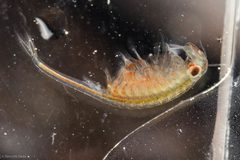
Branchinectidae is a of fairy shrimp in the order Anostraca, containing two : Branchinecta and Archaebranchinecta. The genus Branchinecta comprises approximately 50 distributed on all continents except Africa and Australia, while Archaebranchinecta contains only two species: the extant A. pollicifera and the fossil A. barstowensis. Members inhabit temporary and permanent aquatic ranging from Arctic ponds to prairie pools, with some species exhibiting cold stenothermy. The family is distinguished from other anostracans by specific morphological features of the male second and female dorsum ornamentation.
Pronunciation
How to pronounce Branchinectidae: //ˌbræŋˌkaɪˈnɛk.tɪˌdiː//
These audio files are automatically generated. While they are not always 100% accurate, they are a good starting point.
Identification
Branchinectidae are distinguished from other anostracan primarily through detailed examination of male second and female dorsum ornamentation patterns. Within the family, species-level identification relies on specific characters: the form of the male second antennal antennomere and the ornamentation of the female dorsum serve as key diagnostic features. For example, Branchinecta lutulenta is separable from by these characters, and B. serrata is distinguished from the similar B. paludosa by subtle morphological differences requiring detailed examination.
Images
Habitat
include temporary and permanent aquatic systems: small pools, prairie pools, Arctic ponds and lakes, and high Arctic water bodies. Branchinecta paludosa is cold stenothermic, inhabiting Arctic ponds and lakes where hatch with snowmelt. Branchinecta lutulenta occurs in small, muddy pools. The shows broad habitat across geochemical gradients, with some co-occurring with other anostracans such as Artemia franciscana.
Distribution
Branchinecta occurs on all continents except Africa and Australia. Specific records include: North America (Idaho, Oregon, Washington, central USA, central Canada, including the northernmost record for the genus at 82°47'N in North Greenland); circumpolar Arctic distribution for B. paludosa; Antarctic distribution for B. gaini. The fossil Archaebranchinecta barstowensis is known from specific deposits.
Seasonality
In Arctic and high-latitude , activity is tied to snowmelt, with hatching in spring and full development occurring during short summer periods. Seasonal activity patterns in temperate and prairie regions correspond to temporary pool hydroperiods, though specific timing varies by and locality.
Life Cycle
are a characteristic stage, allowing persistence through unfavorable conditions. Eggs normally hatch with snowmelt in high-latitude , with complete development occurring during the abbreviated Arctic summer. Specific details of naupliar and post-naupliar development stages vary among but follow the general anostracan pattern of gradual .
Human Relevance
Branchinectidae serve as indicators of aquatic quality and hydroperiod characteristics in temporary water systems. Some species have restricted distributions and specific habitat requirements, leading to conservation interest; for example, Branchinecta serrata conservation status has been revised based on expanded distributional knowledge. The has contributed to phylogenomic studies of anostracan evolution, with complete mitochondrial sequenced for B. paludosa and B. gaini.
Similar Taxa
- ChirocephalidaeAnother of Anostraca; distinguished by differences in male and female pouch structure
- Artemiidae containing brine shrimp; Branchinectidae may co-occur with Artemia franciscana but differ in preferences and morphological details
- Thamnocephalidae of fairy shrimp with superficially similar body plan; separation requires examination of specific antennal and genital characters
More Details
Taxonomic history
The was originally monogeneric, containing only Branchinecta. The Archaebranchinecta was subsequently erected to accommodate A. pollicifera and the fossil A. barstowensis.
Phylogenomic resources
Complete mitochondrial have been published for Branchinecta paludosa (16,059 , from North Greenland) and B. gaini, providing resources for understanding anostracan phylogenetic relationships and geographical distribution patterns.
Sources and further reading
- BugGuide
- Wikipedia
- GBIF taxonomy match
- iNaturalist taxon
- NCBI Taxonomy
- Catalogue of Life
- The complete mitochondrial genome of the Arctic fairy shrimp Branchinecta paludosa (Müller, 1788) (Anostraca, Branchinectidae) from Sirius Passet, North Greenland
- Annotated Checklist of the large branchiopod crustaceans of Idaho, Oregon and Washington, USA, with the “rediscovery” of a new species of Branchinecta (Anostraca: Branchinectidae)
- Canadian records of Branchinecta serrata Rogers, 2006 and its confusion with B. paludosa (Müller, 1788) (Branchiopoda: Anostraca: Branchinectidae), with a key to the B. paludosa species group
- The complete mitochondrial genome of the Antarctic fairy shrimp Branchinectagaini Daday, 1910 (Branchiopoda, Anostraca, Branchinectidae).