
Artemia
Leach, 1819
brine shrimp
Species Guides
2- Artemia franciscana(San Francisco brine shrimp)
- Artemia monica(Mono Lake brine shrimp)
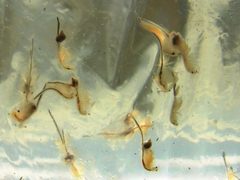
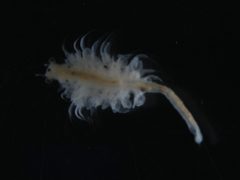
Artemia is a of aquatic crustaceans commonly known as brine shrimp, the sole genus in the Artemiidae. The genus comprises both bisexual and parthenogenetic with considerable variation in salinity and temperature tolerances among . Species show ecological isolation based on lakewater chemistry differences, with competitive hierarchies established between sympatric . Artemia has remained morphologically conservative since the .

Pronunciation
How to pronounce Artemia: /ɑːrˈtiːmiə/
These audio files are automatically generated. While they are not always 100% accurate, they are a good starting point.
Identification
External has changed little since the Triassic; -level identification requires examination of reproductive mode (bisexual versus parthenogenetic) and biochemical/physiological profiles rather than gross morphology. New World are exclusively bisexual and mostly belong to the A. franciscana superspecies; European, Asian, and African populations include both bisexual and parthenogenetic forms.
Images
Habitat
Inhabits sodium chloride lakes and hypersaline waters. show -specific variation in to different ionic compositions, with ecological isolation maintained by intolerance for each other's natural based on lakewater chemistry. Temperature and salinity optima differ among species and populations.
Distribution
in saline lakes worldwide. A. tunisiana occurs in the Mediterranean region including Spain, North Africa, and Mediterranean Islands such as Cyprus. New World are dominated by the A. franciscana superspecies. GBIF records confirm presence in Kenya, Bahamas, Norway, and Thailand.
Life Cycle
Females reproduce either ovoviviparously, releasing free-swimming nauplius larvae, or oviparously, producing encysted embryos. Reproductive mode is environmentally plastic: favorable conditions promote ovoviviparity, while adverse conditions induce oviparity. Individual females differ genetically in their tendency toward either mode.
Human Relevance
Widely used in life-sciences research and aquaculture. Historical records of use date to 10th century Iran, where Artemia from Urmia Lake was described as an "aquatic dog."
More Details
Reproductive biology
The contains both bisexual and parthenogenetic strains. North American are exclusively bisexual, while European, Asian, and African populations include both reproductive modes.
Competitive interactions
A. franciscana outcompetes A. parthenogenetica in 91% of experimental trials, suggesting competitive exclusion shapes distributions where ranges overlap.
Evolutionary stasis
Morphological conservatism since the Triassic makes Artemia a notable example of evolutionary stasis among crustaceans.