
Artemia monica
Verrill, 1869
Mono Lake brine shrimp
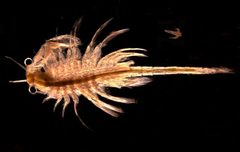
Artemia monica is a brine shrimp to Mono Lake, California. It is a of the widespread A. franciscana, with which it is reproductively isolated due to different water requirements. The species exhibits strong salinity-dependent traits, with higher salinities reducing hatching success, survival, growth, and reproductive output while prolonging developmental timelines.
Pronunciation
How to pronounce Artemia monica: /ɑːrˈtɛmiə ˈmɒnɪkə/
These audio files are automatically generated. While they are not always 100% accurate, they are a good starting point.
Identification
Distinguished from its Artemia franciscana by specificity rather than morphological features; the two are completely prevented from interbreeding due to different water requirements. Specific morphological diagnostic characters are not documented in available sources.
Images
Habitat
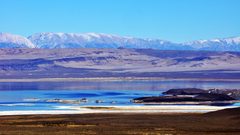
Hypersaline inland waters. Specifically to Mono Lake, California—a closed-basin, alkaline lake with salinity ranging from 76–168 g l−1. The is adapted to extreme hypersaline conditions that prevent coexistence with its A. franciscana.
Distribution
to Mono Lake, Mono County, California, United States. No other natural are known.
Life Cycle
Development is strongly influenced by salinity. Hatching success and survival decrease with increasing salinity. Time to hatching and , as well as inter- duration, increase with elevated salinity. Naupliar survival remains constant between 76–133 g l−1 but declines above 133 g l−1. Reproductive output (ovigery and brood size) decreases as salinity increases.
Human Relevance
Serves as a critical food source for migratory birds at Mono Lake, particularly during seasonal abundance. The has been studied as a model for understanding salinity and plasticity in extremophile crustaceans.
Similar Taxa
- Artemia franciscana widespread in the Americas; reproductively isolated from A. monica due to different water requirements; not found in Mono Lake
More Details
Salinity tolerance
The demonstrates remarkable physiological plasticity across a salinity range of 76–168 g l−1, with salinity explaining 40–93% of variation in ten measured traits. Effects are generally gradual and continuous rather than threshold-based.
Conservation context
to a single lake system, making the vulnerable to changes in lake hydrology and salinity regimes. Mono Lake water diversions in the 20th century threatened lake levels and salinity stability.
Sources and further reading
- BugGuide
- Wikipedia
- GBIF taxonomy match
- iNaturalist taxon
- NCBI Taxonomy
- Catalogue of Life
- The Glory of the Bindweed Turret Bees | Bug Squad
- Christian Nansen Lab: Groundbreaking Research on Plant-to-Plant Communication | Bug Squad
- How Many Tagged Migrating Monarchs Have You Seen? | Bug Squad
- Biodiversity of a Lab: A Community Ecology Perspective
- Search Continues for Methods to Control Fungus-Farming Beetle in SoCal Trees
- Post-fire logging harms Spotted owls | Blog
- Relationships between Artemia monica life history characteristics and salinity