
Pseudeuophrys lanigera
(Simon, 1871)
House Jumping Spider
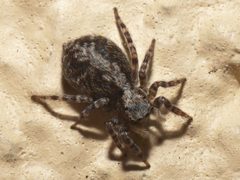
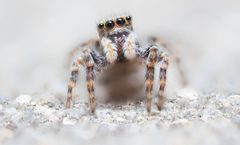
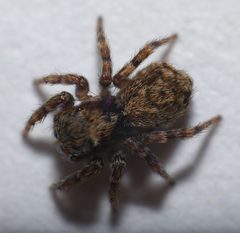
Pseudeuophrys lanigera is a small jumping spider native to southwestern Europe that has expanded its range northward and eastward since the mid-20th century. It is strongly associated with human structures, particularly in northern parts of its range where it is found almost exclusively indoors or on building exteriors. are active year-round, including winter months. The shows notable to dry, heated environments of modern concrete buildings.
Pronunciation
How to pronounce Pseudeuophrys lanigera: //ˌsjuːdjuːˈɒfrɪs ˌlænɪˈdʒɪərə//
These audio files are automatically generated. While they are not always 100% accurate, they are a good starting point.
Identification
Very similar to Pseudeuophrys erratica, but P. lanigera is predominantly found inside buildings while P. erratica occurs below bark on forest fringes and is rarer. P. lanigera is better adapted to dry conditions of modern concrete architecture compared to other regional salticids such as Salticus scenicus.
Images
Appearance
Small jumping spider with males 3–4 mm and females up to 5 mm in body length. Coloration and pattern details are not explicitly described in sources.
Habitat
Strongly , especially in northern Europe where it occurs almost exclusively inside houses or on external building walls. In southern parts of native range, occupies broader environments. Thrives in dry, heated conditions of modern concrete buildings.
Distribution
Native to southwestern Europe; expanded northward to Germany (first recorded 1950s), Poland (first recorded 1999), and Romania (first recorded 2007). Range extends eastward to Caucasus, Turkey, and Iran. Introduced to USA. Present throughout western and southern Europe.
Seasonality
active year-round, including deep winter. No seasonal dormancy period observed.
Diet
Has been observed feeding on booklice (Liposcelis spp.).
Ecological Role
of small arthropods in human-built environments.
Human Relevance
Common household spider in parts of Europe; presence indicates successful to human-altered environments. Not known to cause harm to humans or structures.
Similar Taxa
- Pseudeuophrys erraticaVery similar in appearance, but distinguished by : P. erratica is rarer and found below bark on forest fringes, not inside buildings.
- Salticus scenicusAnother regional salticid, but P. lanigera is better suited to dry conditions of modern concrete architecture.
More Details
Etymology
name 'lanigera' means wool-bearing. name derives from Greek: 'pseud' (looking like) + 'eu' (good) + 'ophrys' (eyebrows), referring to resemblance to genus Euophrys ('beautiful eyebrows').
Range expansion
Originally restricted to Southwest Europe, this has undergone significant northward and eastward expansion since the 1950s, correlating with increased urbanization and indoor heating.