
Salticus scenicus
(Clerck, 1757)
Zebra Jumping Spider, Zebra Spider, Zebra Back Spider
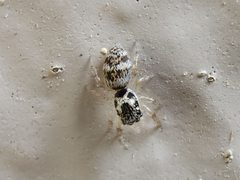
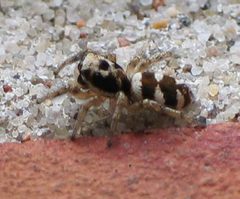
Salticus scenicus is a small jumping spider recognized by its bold black-and-white striped pattern. females measure 4–7 mm in body length, males 4–6 mm. Males exhibit elongated with long fangs used in combat with rival males. The is native to Eurasia but has spread globally through human commerce, now common across temperate regions of North America and Europe. It is frequently observed on vertical surfaces such as walls and fenceposts in urban and suburban environments.
Pronunciation
How to pronounce Salticus scenicus: //ˈsæl.tɪ.kʊs ˈskɛ.nɪ.kʊs//
These audio files are automatically generated. While they are not always 100% accurate, they are a good starting point.
Identification
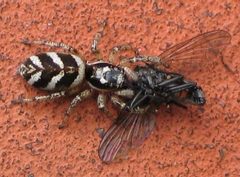
Distinguished from other jumping spiders by its vivid black-and-white coloration; males are almost exclusively black and white with greatly elongated and long fangs, while females have a more mottled pattern with beige or tan streaks breaking the black-and-white design. The compact body and distinctive striping separate it from similarly sized salticids like Sassacus , which have shorter legs and iridescent rather than striped patterning.
Images
Habitat
Frequently associated with vertical man-made structures including building walls, fenceposts, and other artificial surfaces. Most common in urban and suburban settings.
Distribution
Native to Eurasia; now widespread across temperate regions globally. In North America, ranges across the northern tier of states south to southern California, Colorado, northern Texas, Ohio, and North Carolina. Present throughout Europe, Russia (from Europe to Far East), Caucasus, Kazakhstan, and Iran.
Seasonality
Mature specimens active from April through October in North America; males appear earlier in the season than females. Subadult specimens overwinter in protected .
Diet
taking insects and spiders up to its own size or smaller. Documented prey includes blow flies (Lucilia sp., Calliphoridae).
Life Cycle
Mating occurs early in the season; spiderlings grow during summer months. Subadults overwinter in protected locations and reach maturity the following spring.
Behavior
Does not build webs for prey capture. Uses four pairs of large to locate and stalk prey before pouncing. When hunting, orients toward prey detected by lateral eyes when the angle subtended exceeds 5.5°; only moving objects elicit orientation. Stalk velocity declines progressively as the spider nears stationary prey. Males engage in visual and use elongated to duel with rival males, interlocking jaws in combat analogous to bull elk. Spins dragline silk as a safety measure when leaping. Occasionally enters buildings.
Ecological Role
of small insects and other arthropods in urban and suburban .
Human Relevance
Beneficial in human-modified environments, helping control of small insects. Frequently encountered on building walls and fences, making it one of the more noticeable spider in urban areas. Not dangerous to humans despite sometimes being perceived as aggressive due to its alert, curious .
Similar Taxa
- Sassacus speciesSimilar small size and jumping spider habit, but Sassacus has very short legs, iridescent coloration rather than bold striping, and compact -mimic appearance.
- Attulus distinguendus (Distinguished Jumping Spider)Both are small jumping spiders with striking appearance, but A. distinguendus is much rarer, restricted to brownfield sites in the UK, and lacks the zebra striping.
Sources and further reading
- BugGuide
- GBIF taxonomy match
- iNaturalist taxon
- NCBI Taxonomy
- Catalogue of Life
- Bug Eric: Zebra Jumper
- Bug Eric: Spider Sunday: Sassacus
- Distinguished Jumping Spider – Jumping into Oblivion - Buglife Blog - Buglife
- Bug Eric: Spider Sunday: Striped Lynx Spider
- Bug Eric: Spider Sunday: Slender Crab Spiders (and their look-a-likes)
- Predatory behavior of the zebra spider, Salticus scenicus (Araneae: Salticidae)
- Structural Organization and Statistical Analysis of Pedipalps in Two Salticid Spider Species: Salticus scenicus and Plexippus petersi