
Salticus
Latreille, 1804
Zebra spiders, Jumping spiders
Species Guides
4- Salticus austinensis(zebra spider)
- Salticus palpalis
- Salticus peckhamae
- Salticus scenicus(Zebra Jumping Spider)
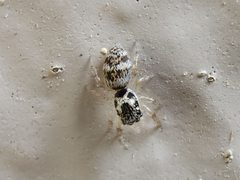
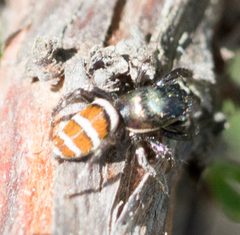
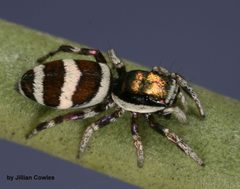
Salticus is a of jumping spiders (Salticidae), the type genus for the . range from 3–7 mm in body length and are distinguished by coloration produced by specialized covering a dark . Several common species exhibit transverse black-and-white striping that gives the group its "zebra spider" , though some species display iridescent or red-and-white patterns instead. The genus has been recorded on every continent except Antarctica, with highest diversity in the southwestern United States, Mexico, and the Mediterranean region.
Pronunciation
How to pronounce Salticus: //ˈsal.ti.kʊs//
These audio files are automatically generated. While they are not always 100% accurate, they are a good starting point.
Identification
Distinguished from other salticid by the specific -based coloration patterns and, in males, the pronounced elongation of and . The zebra-striped (notably S. scenicus) are readily recognized by their bold black-and-white transverse abdominal stripes, though similar striping occurs in unrelated spiders such as lynx spiders (Oxyopes salticus) and slender crab spiders (Tibellus). Unlike Oxyopes, Salticus lacks the long leg spines and high "forehead" of lynx spiders; unlike Tibellus, Salticus does not have the extremely elongated body form and is more compact with a flatter . Iridescent Salticus species may resemble -mimicking jumping spiders such as Sassacus, but Salticus typically shows more conventional spider-like proportions and lacks the very short legs and compact, rounded body of Sassacus.
Images
Habitat
Open, sunny with vertical surfaces including man-made structures (walls, fences) and natural substrates (tree trunks). Frequently found near water sources. Prefers exposed, well-lit environments rather than dense vegetation or shaded forest interiors.
Distribution
Recorded from every continent except Antarctica. Two centers of diversity: southwestern United States extending into Mexico, and the Mediterranean region. The widespread Holarctic S. scenicus is strongly associated with human habitations and has been introduced globally through human commerce.
Seasonality
Active primarily during warmer months. In temperate regions, mature specimens observed from April through October, with males appearing earlier than females. Subadults overwinter in protected .
Diet
Active of small arthropods. Dipterans (flies) constitute approximately 70% of prey items in one study; emergent aquatic gnats are commonly taken near water. Has been observed capturing prey several times body size, including large blow flies (Calliphoridae).
Life Cycle
Mating occurs early in the active season. Spiderlings develop through summer months. Subadult stage overwinters in protected locations, reaching maturity the following spring.
Behavior
Visual hunters that stalk and pounce on prey. Approaches prey with progressively decreasing velocity as distance closes. Prior to jumping, deposits silk dragline as safety anchor. Males use elongated in combat with rival males, interlocking jaws in display contests. Courtship involves visual displays; males of at least some produce auditory stimuli through abdominal twitching. Curious and alert, frequently turning toward movement.
Ecological Role
in open and urban environments. Contributes to control of fly , particularly near aquatic habitats where emergent insects are abundant.
Human Relevance
Common and conspicuous in urban and suburban settings due to affinity for vertical man-made surfaces. S. scenicus is one of the most frequently observed jumping spiders on citizen science platforms. Not dangerous to humans; bites are not considered medically significant. Subject of behavioral research due to accessible urban and distinctive appearance.
Similar Taxa
- SassacusBoth contain small, iridescent, -mimicking , but Sassacus has extremely short legs (fourth pair longest), very compact rounded body, and different proportions
- Oxyopes (especially O. salticus)Striped lynx spiders share transverse striping pattern but have long leg spines, high forehead with different arrangement, and more slender build
- TibellusSlender crab spiders share vertical striping and grassland but have extremely elongated flattened bodies and hunt on vegetation stems rather than vertical surfaces
More Details
Etymology
name derived from Latin "saltus" meaning leap or jump, referring to the characteristic jumping locomotion of salticid spiders
Type genus status
Salticus is the type for Salticidae, establishing the taxonomic reference point for the entire jumping spider family
Scale-based coloration
Unlike most spiders where color derives from pigments, Salticus coloration is structural, produced by modified setae (). This allows for iridescent effects and rapid evolutionary modification of appearance through scale changes rather than pigment alterations
Sources and further reading
- BugGuide
- Wikipedia
- GBIF taxonomy match
- iNaturalist taxon
- NCBI Taxonomy
- Catalogue of Life
- Bug Eric: Zebra Jumper
- Bug Eric: Spider Sunday: Striped Lynx Spider
- Bug Eric: Spider Sunday: Sassacus
- Bug Eric: Spider Sunday: Slender Crab Spiders (and their look-a-likes)
- Distinguished Jumping Spider – Jumping into Oblivion - Buglife Blog - Buglife
- Predatory behavior of the zebra spider, Salticus scenicus (Araneae: Salticidae)
- The jumping lynx spider Oxyopes salticus Hentz, 1845 and its Neotropical relatives (Araneae: Oxyopidae)
- Sublethal pesticide exposure disrupts courtship in the striped lynx spider, Oxyopes salticus (Araneae: Oxyopidae)
- Structural Organization and Statistical Analysis of Pedipalps in Two Salticid Spider Species: Salticus scenicus and Plexippus petersi
- The lethal and sublethal effects of three pesticides on the striped lynx spider (Oxyopes salticus Hentz)