
Sassacus
G. W. Peckham & E. G. Peckham, 1895
Leaf-beetle Jumping Spiders
Species Guides
4- Sassacus cyaneus
- Sassacus paiutus
- Sassacus papenhoei
- Sassacus vitis(Buttonhook Leafbeetle Jumping Spider)
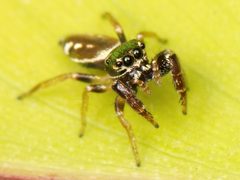
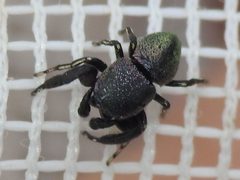
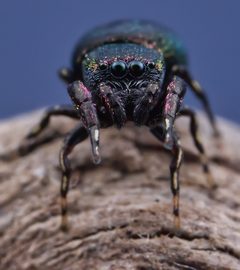
Sassacus is a of jumping spiders (Salticidae) first described in 1895. are exceptionally small, measuring 3-5 mm (males) or 4.4-5.5 mm (females). Many exhibit iridescent coloration and compact bodies, suspected to mimic chemically defended leaf beetles (Chrysomelidae). The genus occurs across North America from southern British Columbia through Central America, inhabiting broadleaved plants in open fields and forest edges.
Pronunciation
How to pronounce Sassacus: //ˈsæs.ə.kəs//
These audio files are automatically generated. While they are not always 100% accurate, they are a good starting point.
Identification
Very short legs relative to body size, with the fourth pair longest and third pair second-longest. First pair of legs thickest, bearing one or two pairs of spines used in prey capture. Many covered in iridescent giving metallic appearance. Body compact and small (under 6 mm). Extremely short legs distinguish Sassacus from most other salticid .
Images
Habitat
Broadleaved plants in open fields and along forest edges. Prairie with vegetation close to the ground.
Distribution
Southern British Columbia south through the United States into Central America. Widespread across continental U.S. including Colorado.
Behavior
Males perform visual involving zigzag or spiral approaches to females, raising and crossing front legs to gain attention, then raising and lowering front legs until accepted or rejected. Abdominal twitching during courtship produces audible sounds that have been recorded in laboratory settings.
Ecological Role
Suspected leaf beetle mimic; iridescent coloration likely advertises unpalatability to through resemblance to chemically defended chrysomelid beetles.
Similar Taxa
- AgassaFormerly recognized as separate , now synonymized with Sassacus (Richman 2008 revision)
- MetaphidippusSome groups transferred to Sassacus during 2008 revision