
Sassacus cyaneus
(Hentz, 1846)
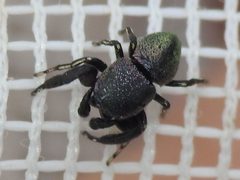
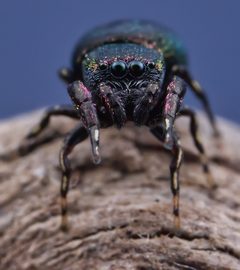
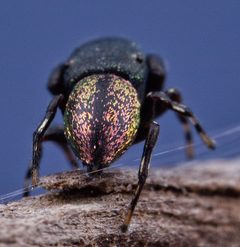
Sassacus cyaneus is a small jumping spider native to eastern and central North America. measure 2.4-4.8 mm in body length, with females larger than males. The exhibits distinctive metallic coloration and a compact, -like appearance that may serve as of chemically defended leaf beetles (Chrysomelidae). Originally described as Attus cyaneus in 1846, it was transferred to Sassacus in 2008 when the Agassa was synonymized. The specific epithet refers to the dark blue metallic coloration.
Pronunciation
How to pronounce Sassacus cyaneus: //ˈsæs.ə.kʊs siˈeɪ.ni.əs//
These audio files are automatically generated. While they are not always 100% accurate, they are a good starting point.
Identification
Distinguished from similar jumping spiders by the square, box-like and -like compact body form. Differs from the closely related Sassacus papenhoei in carapace shape. The combination of metallic coloration, very short legs with the fourth pair longest, and the distinctive row of setae on the separates it from other small salticids. The yellow on the first legs and long hairs on the anterior dorsal opisthosoma are additional diagnostic features.
Images
Habitat
Found on small shrubs, small oak trees, and scrub pines. Occupies with woody vegetation where it can hunt prey and construct retreats. Occurs in open fields and along forest edges with broadleaved plants.
Distribution
Eastern and central North America. Documented from Canada and the United States: Connecticut, Florida, Georgia, Illinois, Massachusetts, Missouri, New Jersey, New York, North Carolina, Ohio, Pennsylvania, South Carolina, Texas, Virginia, West Virginia, and Wisconsin. Range extends from New England south to Florida and west to Texas, Missouri, and Wisconsin.
Seasonality
Active from April through September. Males collected in May; females found from June through September. One female observed laying in July.
Diet
feeding on small arthropods. Specific prey items not documented in detail.
Life Cycle
. One female laid 5 in July 1966. Developmental stages and detailed otherwise undocumented.
Behavior
Visual involving zigzag or spiral approaches by males, with raising and crossing of front legs once female attention is gained, followed by repeated raising and lowering of front legs. Abdominal twitching during courtship produces auditory signals. Constructs retreats in woody vegetation.
Ecological Role
of small arthropods in shrub and tree . Suspected Batesian mimic of chemically defended leaf beetles (Chrysomelidae), potentially gaining protection from predators through resemblance to unpalatable beetles.
Human Relevance
No documented economic or medical importance. Subject of taxonomic and behavioral research. Potential interest for biological study due to mimicry system and specialized predatory .
Similar Taxa
- Sassacus papenhoeiClosely related ; differs in shape
- Sassacus alboguttatusShares characteristic row of setae on but differs in color pattern and distribution
- Sassacus vitisCongeneric occurring in overlapping range, less -like in appearance
More Details
Taxonomic history
First described by Nicholas Marcellus Hentz in 1846 as Attus cyaneus. Placed in Agassa by many authors until David B. Richman transferred it to Sassacus in 2008, making Agassa a junior synonym. The genus name Sassacus honors the last chief of the Pequot Indians.
Mimicry system
A female collected in Florida was found on a bush with numerous leaf beetles in the Graphops (Chrysomelidae: Eumolpinae), supporting the hypothesis of given the spider's -like appearance and metallic coloration typical of chemically defended chrysomelids.
Sources and further reading
- BugGuide
- Wikipedia
- GBIF taxonomy match
- iNaturalist taxon
- Catalogue of Life
- Grasshoppers of Colorado
- Grasshoppers of Colorado
- Encyrtid Holdings | Entomology Research Museum
- Grasshoppers of Wyoming and the West
- Bug Eric: Spider Sunday: Sassacus
- Harpoon Heads, Sweeping Tails: How Predatory Mosquito Larvae Capture Prey