
Sassacus papenhoei
G.W. Peckham & E.G. Peckham, 1895
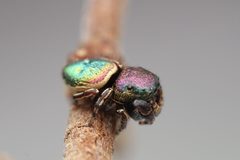
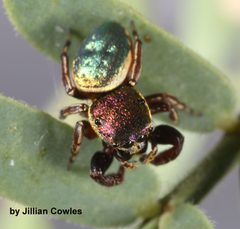
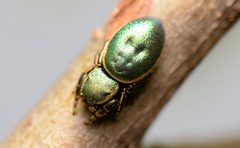
Sassacus papenhoei is a small jumping spider in the Salticidae, native to North America. males measure approximately 3–5 mm, while females are slightly larger at 4.4–5.5 mm. The species exhibits compact body proportions with notably short legs, and is suspected to be a mimic of iridescent leaf beetles (Chrysomelidae). It has been documented in Colorado and across a range extending from southern British Columbia through the United States into Central America.
Pronunciation
How to pronounce Sassacus papenhoei: //ˈsæsəˌkʊs ˌpæpənˈhoʊ.i//
These audio files are automatically generated. While they are not always 100% accurate, they are a good starting point.
Identification
Distinguished from other jumping spiders by its extremely short legs and compact, -like body shape. The iridescent scaling and metallic coloration separate it from most other salticids. Within the Sassacus, S. papenhoei can be differentiated from S. vitis and other by specific morphological details in the original description (Peckham & Peckham, 1895). The combination of small size, short legs, and iridescent coloration is distinctive.
Images
Appearance
Very small jumping spider with a compact, stocky build. males: 3–5 mm; adult females: 4.4–5.5 mm. Legs are notably short relative to body size, with the fourth pair longest, followed by the third pair. First pair of legs is the thickest, bearing one or two pairs of spines used in prey capture. Body covered in iridescent producing metallic coloration. The compact, rounded appearance resembles that of certain leaf beetles.
Habitat
Found on broadleaved plants in open fields and along forest edges. Prairie with flowering vegetation. Occurs in areas with sufficient plant cover to support prey .
Distribution
North America. Documented from southern British Columbia south through the United States into Central America. Specifically recorded in Colorado Springs, Colorado, USA. Widespread in the U.S. according to revision by Richman (2008).
Seasonality
have been observed in late July in Colorado. Specific seasonal patterns otherwise not well documented.
Behavior
Engages in visual typical of jumping spiders. Males make zigzag or spiral approaches to females, raising and crossing their front legs to gain attention, then raising and lowering front legs until accepted or rejected. Abdominal twitching during courtship produces audible signals that have been recorded in laboratory settings.
Ecological Role
Suspected Batesian mimic of iridescent leaf beetles (Chrysomelidae), which may advertise unpalatability or to . As a small jumping spider, likely functions as a predator of small insects and other arthropods in its .
Human Relevance
name "Sassacus" references the last chief of the Pequot Indians, a Native American tribe of the Connecticut Valley defeated in 1637. No documented economic or medical significance. Occasionally encountered by naturalists and photographers in prairie and field .
Similar Taxa
- Sassacus vitisCongeneric with overlapping distribution in Colorado; both share compact body form and short legs but differ in specific morphological details
- Iridescent leaf beetles (Chrysomelidae)S. papenhoei is suspected to mimic these beetles in appearance, sharing metallic coloration and compact rounded body shape as a defensive strategy
More Details
Taxonomic history
The Sassacus was revised by Richman (2008) to include formerly placed in the genus Agassa and one species group from Metaphidippus. Depending on authority, three to nine species are recognized in North America including Mexico.
Sound production
Maddison and Stratton (1988) demonstrated that abdominal twitching during courtship produces an auditory stimulus, a trait shared with many other jumping spider .