
Sassacus vitis
(Cockerell, 1894)
Buttonhook Leafbeetle Jumping Spider
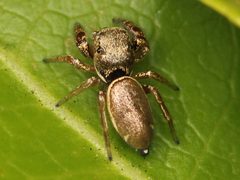
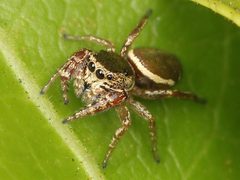
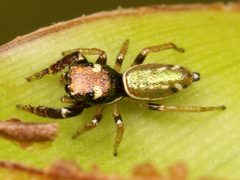
Sassacus vitis is a small jumping spider native to North America, ranging from Canada to Panama. females measure 4.4–5.5 mm, while males are smaller at 3–5 mm. The exhibits strong in size and coloration, with females being larger and duller than males. It is one of several species in the Sassacus, which are suspected mimics due to their compact, iridescent appearance.
Pronunciation
How to pronounce Sassacus vitis: /ˈsæsəkəs ˈviːtɪs/
These audio files are automatically generated. While they are not always 100% accurate, they are a good starting point.
Identification
Distinguished from other jumping spiders by extremely short legs (fourth pair longest, first pair thickest with spines) and compact, -like body with iridescent . Sexual size dimorphism pronounced. Distinguished from other Sassacus by geographic range and subtle morphological features; S. papenhoei occurs sympatrically in some areas including Colorado. The beetle-mimic appearance separates it from more typical spider-shaped salticids.
Images
Appearance
Small jumping spider with compact body and iridescent coloration. females 4.4–5.5 mm, males 3–5 mm. Females substantially larger and duller in color than males. Very short legs relative to body size; fourth pair longest, third pair next, first pair thickest with one or two pairs of spines used in prey capture. Body covered in iridescent giving metallic appearance.
Habitat
Broadleaved plants in open fields and along forest edges. Associated with sunflowers and other vegetation in prairie and open .
Distribution
North America from southern British Columbia, Canada south through the United States to Panama. Widespread in the U.S. including Colorado, Massachusetts, Illinois, and other states. Present in Mexico and Central America.
Seasonality
observed in summer months; one Colorado record from July 28. Active period likely April–September depending on latitude, though specific not well documented.
Behavior
Visual documented in and likely present in this . Males make zigzag or spiral approaches to females, raising and crossing front legs to gain attention, then raising and lowering front legs until accepted or rejected. Abdominal twitching during courtship produces audible signals. Hunting typical of salticids: stalking prey using excellent vision and jumping to capture.
Ecological Role
Small . Suspected leaf beetle mimic (Chrysomelidae), potentially gaining protection from predators that avoid chemically defended beetles.
Human Relevance
No documented economic or medical significance. Occasionally encountered by naturalists and photographers. One iNaturalist observer noted a seemingly tame individual that did not flee during close interaction.
Similar Taxa
- Sassacus papenhoeiSympatric in Colorado and other areas; distinguished by subtle morphological features per Richman (2008) revision
- Other Sassacus speciesShare compact iridescent appearance and short legs; require careful examination for -level identification
- Salticus scenicus (Zebra Spider)Similar small size and jumping , but has bold black and white stripes rather than iridescent metallic coloration, and longer legs relative to body
More Details
Etymology
The name Sassacus commemorates the last chief of the Pequot Indians, a Native American tribe of the Connecticut Valley defeated in war with English settlers in 1637.
Taxonomic history
The Sassacus was revised by Richman (2008) to include the former genus Agassa and one group from Metaphidippus. Depending on authority, three to nine species recognized in North America including Mexico.
Mimicry hypothesis
Scientists suspect Sassacus are mimics of leaf beetles (Chrysomelidae), which often have metallic warning coloration advertising chemical defenses from plants. The compact body and iridescent resemble these distasteful beetles.
Sources and further reading
- BugGuide
- Wikipedia
- GBIF taxonomy match
- iNaturalist taxon
- NCBI Taxonomy
- Catalogue of Life
- Bug Eric: Spider Sunday: Sassacus
- Bug Eric: A Case of Predator Mimicry in the Bee Fly Genus Epacmus? (Diptera: Bombyliidae)
- Curvature values, a new aspect in the morphology of grapevine seeds | Blog
- Waiter, there’s a fly on my fungus… | Beetles In The Bush
- Bug Eric: True Bug Tuesday: Mirid plant bug
- Exploring arctic plants and lichens