
Eumolpinae
Hope, 1841
Typical leaf beetles
Tribe Guides
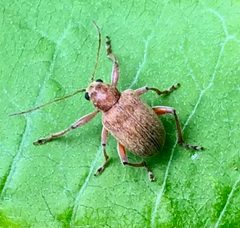
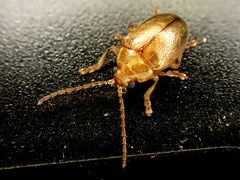
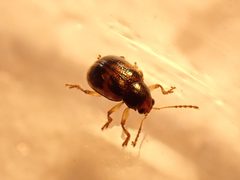
5Eumolpinae is one of the largest of leaf beetles (Chrysomelidae), comprising over 500 and approximately 7,000 . Members are characterized by their oval, convex body form, rounded that are narrower than the , and often brilliant metallic or bright coloration. The subfamily is distributed worldwide but exhibits highest diversity in tropical and subtropical regions, particularly South America, tropical Africa, Australia, New Guinea, and the South Pacific islands. The subfamily contains 12 recognized tribes, though tribal classification varies among authors.
Pronunciation
How to pronounce Eumolpinae: //juːˈmɒlpɪniː//
These audio files are automatically generated. While they are not always 100% accurate, they are a good starting point.
Identification
Eumolpinae can be recognized by their rounded, bell-shaped or spherical that are always significantly narrower than the covered by the . The front are rounded (not transverse) and the third tarsal segment is bilobed beneath—features that distinguish them from other Chrysomelidae . The small is deeply inserted into the thorax. Many resemble other leaf beetles but the combination of thoracic shape and tarsal structure provides definitive identification. Some such as Macrocoma are unusually with prominent for Chrysomelidae.
Images
Habitat
data is sparse and -specific. The flightless genus Apterodina has documented habitat associations in Ecuador, though specific vegetation types are not detailed in available sources. Many are associated with particular plants; for example, the dogbane beetle (Chrysochus auratus) is found on dogbane (Apocynum cannabinum) and milkweed (Asclepias spp.). Some Eumolpinae have been recorded from cacao trees (Theobroma cacao) in Brazil.
Distribution
Worldwide distribution, most numerous in tropics and subtropics. High in South America, tropical Africa, Australia, New Guinea, Fiji, and New Caledonia. Progressively less common towards northern latitudes. Documented from Mediterranean region, Greece, Brazil, Ecuador, Colombia, and New Caledonia.
Diet
Herbivorous; many are associated with specific plants. Chrysochus auratus feeds on dogbane and milkweed leaves as , with larvae feeding on roots. Most species are presumed to be folivorous as adults, but specific diet data is - or species-specific and not generalized for the .
Host Associations
- Apocynum cannabinum - and larval for Chrysochus auratus
- Asclepias spp. - for Chrysochus auratus
- Theobroma cacao - associationEumolpinae recorded from cacao trees in Southeast Bahia, Brazil
Life Cycle
Larval development occurs in soil or within plant tissues. Chrysochus auratus larvae feed on roots of dogbane while feed on leaves. Case-bearing larvae have not been documented in this (this trait occurs in Cryptocephalinae). Specific details vary by and are not generalized for the subfamily.
Behavior
Some members of the Apterodina are flightless. When disturbed, some retract the and fold legs into grooves. Defensive are not well documented for the as a whole.
Ecological Role
Herbivores that function as folivores on various plants; some may contribute to nutrient cycling through root-feeding larval stages. Specific roles are species-dependent and not well characterized for the .
Human Relevance
Some are pests of agricultural crops. Chrysochus auratus (dogbane beetle) is sometimes confused with Japanese beetle but is harmless to crops. Some Eumolpinae associated with cacao may have economic significance. The includes potential biocontrol agents, though specific examples are not well documented.
Similar Taxa
- ChrysomelinaeBoth contain globular leaf beetles, but Eumolpinae are generally smaller and distinguished by rounded front and bilobed third tarsal segment. Chrysomelinae typically have more elongated body forms and different tarsal structure.
- CassidinaeBoth are convex leaf beetles, but Cassidinae (tortoise beetles) have expanded and prothorax that form a shield covering the body, and draw and legs beneath when threatened. Eumolpinae lack this shield-like expansion and have different thoracic proportions.
- CryptocephalinaeBoth contain small, rounded leaf beetles. Cryptocephalinae (including warty leaf beetles in Chlamisini) have case-bearing larvae and some mimic caterpillar —traits not found in Eumolpinae.
More Details
Tribal Classification
The contains 12 tribes according to a 2011 classification: Bromiini (including Adoxini), Caryonodini, Cubispini, Eumolpini, Euryopini, Habrophorini, Hemydacnini, Megascelidini, Merodini, Pygomolpini, Rosiroiini, and Typophorini. Tribal boundaries vary among authors; for example, Bromiini is sometimes split into Myochroini and Scelodontini, and Eumolpini into Iphimeini and Endocephalini.
Taxonomic History
The tribe Eupalini was proposed in 2005 for the Eupales but is currently considered unavailable under ICZN due to lack of explicit indication as a new name. The Spilopyrinae was formerly treated as a tribe of Eumolpinae, and Synetinae has sometimes been grouped within Eumolpinae.
New Caledonian Diversity
New Caledonia harbors a high of Eumolpinae, including an ancient orphan evolutionary lineage to the South Pacific with unique mitochondrial characteristics.
Sources and further reading
- BugGuide
- Wikipedia
- iNaturalist taxon
- NCBI Taxonomy
- Catalogue of Life
- Chrysomelidae | Beetles In The Bush | Page 4
- The Mediterranean Colaspidea (Coleoptera Chrysomelidae Eumolpinae)
- A second species of Apterodina (Chrysomelidae: Eumolpinae) from Ecuador
- Revision of New Caledonian species of Eumolpinae described by K. M. Heller (Coleoptera: Chrysomelidae)
- Eumolpinae associated with cacao trees (Theobroma cacao L.) in Southeast Bahia
- The geographic distribution of Lamprosomatinae, Eumolpinae, Chrysomelinae, Alticinae, Hispinae and Cassidinae in Greece (Coleoptera, Chrysomelidae)
- The first complete mitochondrial genome sequences of an ancient orphan evolutionary lineage of Eumolpinae leaf beetles endemic to the South Pacific.