
Pseudeuophrys erratica
(Walckenaer, 1826)
Black-palped Jumping Spider
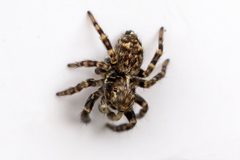
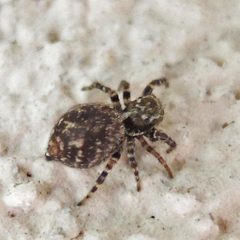
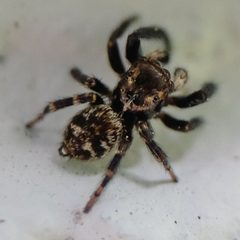
Pseudeuophrys erratica is a small jumping spider native to Europe and Asia that has been introduced to the eastern and western United States. Unlike its P. lanigera, which is abundant in and around buildings, P. erratica is uncommon and prefers natural . are active primarily in spring and summer, with females persisting into autumn.
Pronunciation
How to pronounce Pseudeuophrys erratica: //ˌsjuːd.juˈɒf.rɪs ɛˈræ.tɪ.kə//
These audio files are automatically generated. While they are not always 100% accurate, they are a good starting point.
Identification
Males measure 3–4 mm in body length, females up to 5 mm. Distinguished from the very similar Pseudeuophrys lanigera by preference: P. erratica occurs under bark and rocks in forested areas, while P. lanigera is found almost exclusively in or near buildings.
Images
Habitat
Under bark of trees and under rocks on forest fringes. Occurs in natural wooded environments rather than anthropogenic structures.
Distribution
Native to Europe and Asia, with records from Turkey, the Caucasus, Russia (Europe to Far East), Iran, Kazakhstan, China, Korea, and Japan. Introduced to the United States, with confirmed records from Connecticut, New Jersey, New York, Massachusetts, Oregon, Pennsylvania, Rhode Island, and Vermont.
Seasonality
active in spring and summer; females also present in autumn.
Human Relevance
Introduced in the United States represent a non-native established in urban and suburban environments in the Northeast and Pacific Northwest. Not known to be of economic or medical significance.
Similar Taxa
- Pseudeuophrys lanigeraVery similar in appearance but much more abundant; distinguished primarily by preference (buildings vs. forest fringes)
Sources and further reading
- BugGuide
- Wikipedia
- GBIF taxonomy match
- iNaturalist taxon
- NCBI Taxonomy
- Catalogue of Life
- Bug Eric: My Kind of Fourth of July
- Bug Eric: Filigree Skimmers Are Back
- Gyrinidae | Beetles In The Bush
- Bug Eric: Wasp Wednesday: Another Puzzler
- Bug Eric: Beetle Bonanza
- Bug Eric: National Moth Week Recap for Colorado Springs