
Pelegrina arizonensis
(G. W. Peckham & E. G. Peckham, 1901)
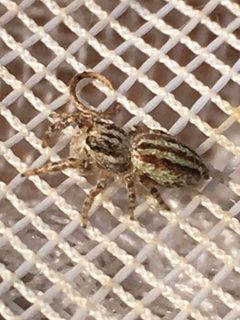
Pelegrina arizonensis is a jumping spider in the Salticidae. Despite its name, the is not known from Arizona; confirmed records exist from Mexico, New Mexico, Texas, and Colorado. Males exhibit a metallic blue-black coloration with a distinctive entirely yellow fringe of hairs on the front legs, while females are larger and display a yellowish appearance with spots and stripes on the . The species inhabits oak woodland understory at elevations between 5,000 and 7,000 feet.
Pronunciation
How to pronounce Pelegrina arizonensis: //ˌpɛlɪˈɡriːnə ˌæɹɪzoʊˈnɛnsɪs//
These audio files are automatically generated. While they are not always 100% accurate, they are a good starting point.
Identification
Males distinguished from by the entirely yellow fringe of hairs on front legs. Females recognized by yellowish ground color with spotted and striped abdominal pattern. Distinguished from Phidippus arizonensis (a larger jumping spider with different coloration and leg fringes) by smaller size and specific leg fringe coloration. The was once considered potentially with an undescribed species known only from females in New Mexico, but this remains unresolved.
Images
Habitat
Understory of oak woodlands, particularly Gambel's Oak (Quercus gambelii) associations. Found on tree trunks and in shrubby vegetation. Elevation range 5,000–7,000 feet.
Distribution
Mexico, New Mexico, Texas, and Colorado (including Colorado Springs). Not recorded from Arizona despite the specific epithet. A 2013 record from Colorado Springs represented a probable state record for Colorado.
Behavior
Observed ascending tree trunks in late afternoon. Readily accepts prey in captivity. Like other salticids, likely an active visual hunter.
Ecological Role
in oak woodland understory . Presence on tree trunks may influence herbivore ; observed in association with Red-shouldered Bugs (Jadera haematoloma) which remained at ground level potentially due to this risk.
Human Relevance
Occasionally collected and maintained in captivity for observation and photography. One 2013 Colorado specimen was retained alive for study and subsequently preserved for the Colorado Spider Survey at the Denver Museum of Nature and Science.
Similar Taxa
- Phidippus arizonensisSimilar specific epithet and geographic reference, but larger jumping spider with different male coloration (not metallic blue-black) and leg fringe characteristics. Belongs to different (Phidippus vs. Pelegrina).
- Polistes arizonensisShares specific epithet but is a paper wasp (Hymenoptera: Vespidae), not a spider. No morphological or ecological similarity.
- Hadrurus arizonensisShares specific epithet but is a giant hairy desert scorpion (Arachnida: Scorpiones), not a spider. Much larger, different (desert vs. oak woodland), and different .
- Scolopendra heros arizonensisShares epithet as a of the giant desert centipede, but is a (Chilopoda) with no relation to spiders. Drastically different size, , and .
Misconceptions
The specific epithet 'arizonensis' is misleading, as the has not been documented from Arizona. This may reflect historical collection locality data or the origin, but current records indicate the species occurs east and north of Arizona.
More Details
Taxonomic Uncertainty
Dr. G.B. Edwards noted that a male specimen from Colorado Springs could potentially represent an undescribed species, with females of a similar undescribed form collected in New Mexico. The specimen was provisionally identified as Pelegrina arizonensis as the more likely scenario.
Discovery Context
The 2013 Colorado record resulted from targeted investigation of Red-shouldered Bug , illustrating how opportunistic observation can yield significant distributional records for poorly known .
Sources and further reading
- BugGuide
- GBIF taxonomy match
- iNaturalist taxon
- NCBI Taxonomy
- Catalogue of Life
- Bug Eric: Wasp Wednesday: Polistes arizonensis
- Destination Sonoran Desert: A time to sting for the Giant Hairy Desert Scorpion, 'Hadrurus arizonensis' — Bug of the Week
- Bug Eric: A Spider Surprise
- North America’s largest centipede | Beetles In The Bush