
Phidippus arizonensis
(G.W. Peckham & E.G. Peckham, 1883)
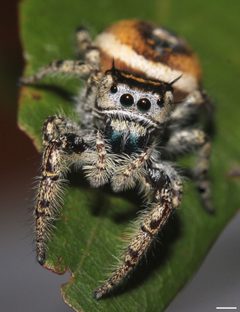
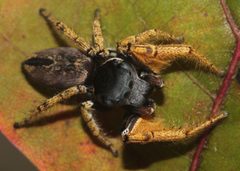
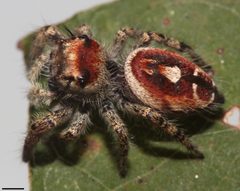
Phidippus arizonensis is a jumping spider in the Salticidae. Despite its name, it is not known from Arizona. Males average slightly over 9 mm in body length and exhibit a metallic blue-black coloration with a distinctive entirely yellow fringe of hairs on the front legs. Females are larger, reaching up to 13.4 mm, and have a yellowish appearance with spots and stripes on the . The has been documented as a probable state record in Colorado, expanding its known range.
Pronunciation
How to pronounce Phidippus arizonensis: /ˈfɪdɪpəs ˌɛrɪzoʊˈnɛnsɪs/
These audio files are automatically generated. While they are not always 100% accurate, they are a good starting point.
Identification
The entirely yellow fringe of hairs on the front legs of males is diagnostic for this and not found in other Phidippus species. Females may be distinguished from other Phidippus by the combination of yellowish coloration with spotted and striped abdominal pattern. Similar species include other Phidippus jumping spiders, but these lack the specific leg fringe coloration and male color pattern.
Images
Appearance
Males average 8.35–10.02 mm in body length; females 9.02–13.36 mm. Males display a vaguely metallic blue-black color. The fringe of hairs on the front legs is entirely yellow, a trait unique to this within the . Females have an overall yellowish appearance with spots and stripes on the .
Habitat
Historical collection records indicate this is most often found in the understory of oak woodlands at elevations between 5,000 and 7,000 feet. The Colorado Springs record came from a sandstone ridge dominated by stunted Gambel's Oak shrubs.
Distribution
United States (Colorado, New Mexico, Texas) and Mexico. Despite the specific epithet, the has not been documented from Arizona. A 2013 record from Colorado Springs, Colorado, at 6,025 feet elevation, represented a probable state record and range extension.
Seasonality
Activity period not well documented. The Colorado record was from late October. Mature individuals have been observed in autumn.
Behavior
Observed ascending tree trunks in oak woodland understory. One individual was documented stalking prey (Yellow Dung Fly) by moving beneath and out of sight of the quarry, demonstrating typical salticid stealth hunting .
Similar Taxa
- Phidippus octopunctatusAnother Phidippus with western U.S. distribution, but males have silvery gray coloration rather than metallic blue-black, and lack the entirely yellow front leg fringe.
- Phidippus asotusOverlaps in elevation range (5,000–7,000 feet) and general , but males are pale orange rather than blue-black, and neither sex has the diagnostic yellow leg fringe.
Misconceptions
The specific epithet 'arizonensis' incorrectly implies occurrence in Arizona; the has not been documented from that state.
More Details
Taxonomic note
The was originally described as Attus arizonensis by Peckham & Peckham in 1883 before transfer to Phidippus.
Conservation status
A 2013 Colorado record suggested the may be undercollected rather than genuinely rare; distribution records remain sparse.
Sources and further reading
- BugGuide
- Wikipedia
- GBIF taxonomy match
- iNaturalist taxon
- NCBI Taxonomy
- Catalogue of Life
- Bug Eric: A Spider Surprise
- Bug Eric: Spider Sunday: Phidippus octopunctatus
- Bug Eric: Wasp Wednesday: Polistes arizonensis
- Bug Eric: Spider Sunday: Phidippus asotus
- Destination Sonoran Desert: A time to sting for the Giant Hairy Desert Scorpion, 'Hadrurus arizonensis' — Bug of the Week
- Eriopis connexa on soybean in Argentina | Beetles In The Bush