
Phidippus asotus
Chamberlin & Ivie, 1933
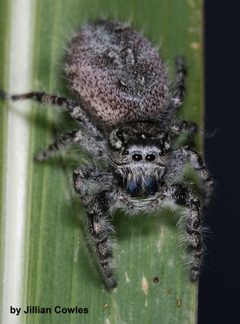
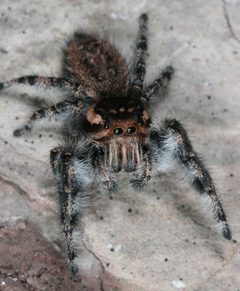
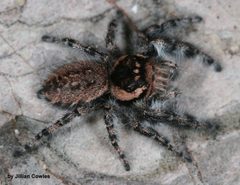
Phidippus asotus is a small jumping spider in the Salticidae, distributed across the southwestern United States and northern Mexico. Both sexes average approximately 7 mm in body length. Males are distinguished by pale orange coloration, while females are less vividly marked. The occupies montane between 5,000–7,000 feet elevation and has been observed hunting on oak, juniper, and various shrubs. mature in fall, with some individuals likely to become active again in spring.
Pronunciation
How to pronounce Phidippus asotus: /fɪˈdɪpəs əˈsoʊtəs/
These audio files are automatically generated. While they are not always 100% accurate, they are a good starting point.
Identification
Distinguished from other Phidippus by geographic range and elevation preference (5,000–7,000 feet). Males identified by pale orange coloration; females require careful comparison with similar sympatric Phidippus. Separated from P. audax and P. octopunctatus by color pattern and . Ten Phidippus species occur in the Pikes Peak region, necessitating detailed examination for definitive identification.
Images
Appearance
Small, densely hairy jumping spider averaging 7 mm in body length. Males typically pale orange in color; females less flamboyantly marked. Possesses the characteristic salticid arrangement: one pair of greatly enlarged, forward-facing eyes. Body form compact and robust, typical of the Phidippus.
Habitat
Montane environments between 5,000–7,000 feet elevation. Associated with oak, juniper, and various shrubs. Observed on vegetation including Oregon Grape (Mahonia/Berberis ).
Distribution
Southwestern United States and northern Mexico. Specifically recorded from California east through northern Utah and Colorado, south to extreme west Texas and northern Mexico.
Seasonality
Matures in fall. females have been observed active in early spring (April), suggesting some individuals overwinter. Activity period likely extends from spring through fall depending on elevation and local conditions.
Diet
Active of small insects. Documented stalking Yellow Dung Fly (Scathophaga stercoraria). Likely predator of small flies and other arthropods encountered on vegetation.
Life Cycle
Matures in fall. sac construction and detailed developmental stages not documented. as inferred from spring observations of mature females.
Behavior
Stealthy visual hunter that actively stalks prey. Alert to human approach; turns to observer. Uses jumping ability to navigate vegetation while hunting. Documented case of hunting beneath flower stalk to remain concealed from fly prey.
Ecological Role
in montane shrubland . Contributes to regulation of small insect .
Human Relevance
No documented negative impacts. Too small to puncture human skin. Engaging appearance and make it subject of interest for nature observation and photography.
Similar Taxa
- Phidippus audaxSimilar size and general appearance; distinguished by bold black and white color pattern with characteristic white spot on
- Phidippus octopunctatusOverlaps in western range; distinguished by larger size (9–10 mm), silvery gray coloration in males, and lower elevation grassland preference
More Details
Photographic behavior
Individuals can be challenging to photograph due to alertness and tendency to turn and observer, though some individuals become cooperative after acclimation
Taxonomic note
One of ten Phidippus documented from the Pikes Peak region; species-level identification requires attention to coloration, pattern, and
Sources and further reading
- BugGuide
- Wikipedia
- GBIF taxonomy match
- iNaturalist taxon
- NCBI Taxonomy
- Catalogue of Life
- Bug Eric: Spider Sunday: Phidippus asotus
- Bug Eric: ArachNovember?
- Bug Eric: April 2012
- Bug Eric: Spider Sunday: Phidippus octopunctatus
- Eriopis connexa on soybean in Argentina | Beetles In The Bush
- Bichos Argentinos #6 – Jumping Spider | Beetles In The Bush