
Peckhamia
Simon, 1900
Species Guides
2- Peckhamia americana(American ant-mimic jumping spider)
- Peckhamia picata(antmimic jumper)
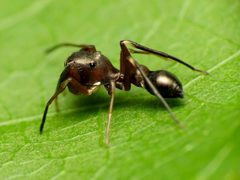
Peckhamia is a of ant-mimicking jumping spiders ( Salticidae) first described by Eugène Louis Simon in 1900, named in honor of arachnologists George and Elizabeth Peckham. in this genus exhibit striking myrmecomorphy—mimicking ants in body shape, movement patterns, and . The genus is distinguished from related -mimicking genera such as Synageles by a more convex in the cephalic area that slopes sharply downward behind the third row of . Peckhamia species characteristically hold their second pair of legs aloft to simulate ant , enhancing their deceptive appearance.
Pronunciation
How to pronounce Peckhamia: //pɛkˈheɪ.mi.ə//
These audio files are automatically generated. While they are not always 100% accurate, they are a good starting point.
Identification
Peckhamia can be distinguished from the related -mimic Synageles by the being more convex in the cephalic area and sharply declivous (downward sloping) behind the third row of . The genus is further characterized by the habit of holding the second pair of legs aloft to create the illusion of . When not in motion, careful observation reveals eight legs rather than six, and the presence of two small near the mouthparts rather than true antennal segments.
Images
Habitat
Found in xeric limestone prairies and glade in North America; Caribbean dry forests in the Greater Antilles.
Distribution
North America east of the Rocky Mountains; Greater Antilles (Cuba, Jamaica, Dominican Republic).
Behavior
Exhibits myrmecomorphy ( mimicry): moves with urgent, halting gait characteristic of ants; holds second pair of legs aloft to simulate . When disturbed, displays rapid, erratic running that makes photography difficult. Has been observed running continuously across surfaces without pausing when pursued.
Similar Taxa
- SynagelesAlso ant-mimicking jumping spiders; distinguished from Peckhamia by less convex in cephalic area and different slope behind third row of
- TutelinaSome also exhibit mimicry and wave front legs like ; distinguished by different body proportions and arrangement
More Details
Etymology
Named in honor of George and Elizabeth Peckham, pioneering American arachnologists known for their work on jumping spiders.
Taxonomic history
Peckhamia is considered a senior synonym of the Consingis. Four were transferred to Peckhamia from other genera in 2020: Sarinda glabra (now P. glabra, designated ), Descanso montanus (P. montana), D. formosus (P. formosa), and D. magnus (P. magna).
Research significance
The is cited in taxonomic literature on jumping spiders, including the key to North American salticid genera published in Peckhamia 1(5):77–81 (1978).
Sources and further reading
- BugGuide
- Wikipedia
- GBIF taxonomy match
- iNaturalist taxon
- NCBI Taxonomy
- Catalogue of Life
- When is an ant not an ant? When it’s a jumping spider, of course! | Beetles In The Bush
- Bug Eric: A Jumping Spider, Tutelina similis
- Bug Eric: A Case of Predator Mimicry in the Bee Fly Genus Epacmus? (Diptera: Bombyliidae)
- Jeepers Creepers, where’d ya get those multilayered retinae? | Beetles In The Bush
- New species of Peckhamia Simon, 1900 (Salticidae: Dendryphantini: Synagelina) from the Greater Antilles