
Synageles
Simon, 1876
antlike jumping spiders
Species Guides
4- Synageles bishopi
- Synageles noxiosus
- Synageles occidentalis
- Synageles venator(Palaearctic Antmimic Jumping Spider)
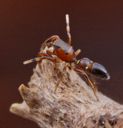
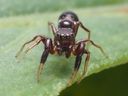
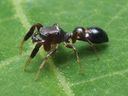
Synageles is a of ant-mimicking jumping spiders ( Salticidae) first described by Eugène Simon in 1876. The genus contains approximately 19–20 described distributed across the Old World from Spain to China, with one species in northern Africa (S. repudiatus from Egypt), and in the New World from Mexico to Canada. These spiders exhibit striking morphological and behavioral mimicry of ants, including holding their second pair of legs aloft to simulate and adopting characteristic -like locomotion.
Pronunciation
How to pronounce Synageles: //sɪˈnædʒəˌliːz//
These audio files are automatically generated. While they are not always 100% accurate, they are a good starting point.
Identification
Distinguished from related -mimicking (particularly Peckhamia) by the more convex in the cephalic area and sharply downward-sloping (declivous) profile behind the third row of . The habit of holding the second pair of legs raised to mimic ant , combined with characteristic scurrying, stop-start locomotion, separates Synageles from actual ants and other spider genera. In North America, S. noxiosus and S. bishopi are among the more frequently encountered .
Images
Habitat
Diverse across temperate and subtropical regions; found in grasslands, open woodlands, forest edges, and riparian areas. Specific microhabitats include vegetation surfaces, ground litter, and tree trunks where ants are common. The type S. venator has been introduced to Canada, suggesting adaptability to anthropogenic habitats.
Distribution
Old World: Spain to China across Europe, Mediterranean region, Turkey, Russia (European to Far East), Kazakhstan, Central Asia, Korea, and Japan. Northern Africa: Egypt (S. repudiatus). New World: Mexico to Canada, including the Bahamas. The spans both Palearctic and Nearctic regions with notable transcontinental range.
Seasonality
Activity patterns vary by and latitude; are generally encountered during warmer months. Specific seasonal data for most species is limited, though the introduced of S. venator in Canada suggests establishment in temperate seasonal climates.
Behavior
Exhibits classic -mimicry (myrmecomorphy) with behavioral and morphological adaptations. Holds second pair of legs aloft to simulate ant . Displays characteristic urgent, halting locomotion that mimics ant movement patterns. This mimicry likely provides protection from that avoid ants due to their chemical defenses or aggressive nature.
Ecological Role
Presumed in ; -mimicry likely serves defensive function against visually hunting predators. Specific ecological impacts have not been quantified.
Human Relevance
No direct economic or medical significance. Of interest to arachnologists and behavioral ecologists studying mimicry systems. The introduced of S. venator in Canada represents a minor case of anthropogenic range expansion.
Similar Taxa
- PeckhamiaAlso -mimicking salticids; distinguished from Synageles by flatter cephalic lacking the sharp declivity behind the third row
- MyrmarachneAnother -mimicking salticid ; generally larger with different body proportions and less pronounced leg-raising
- Actual ants (Formicidae)Synageles mimics ants so effectively that close examination is required; spiders have eight legs (six visible when second pair raised), two body segments, and lack antennal elbow
More Details
Taxonomic history
The was revised by Cutler (1988), who provided a comprehensive treatment of American . The type species is Synageles venator (Lucas, 1836), originally described from Europe and subsequently introduced to Canada. Species boundaries in some groups remain problematic, with S. hilarulus showing particularly wide geographic variation across its extensive range from Europe to Japan.
Mimicry effectiveness
The -mimicry of Synageles is considered highly effective, with the raised leg posture creating a convincing illusion of the elbowed characteristic of many ant . This form of protective mimicry (, assuming the models are unpalatable ants) represents a well-documented case of in spiders.