
Myrmarachne
MacLeay, 1839
ant-mimic spiders, ant-mimicking jumping spiders
Species Guides
1- Myrmarachne formicaria(Ant-mimicking jumping spider)
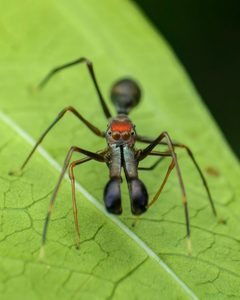
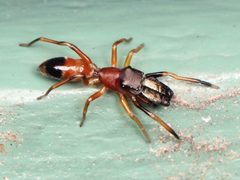
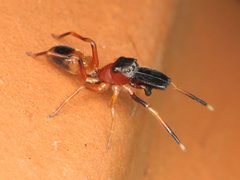
Myrmarachne is a large of -mimicking jumping spiders (Salticidae) first described by MacLeay in 1839. With approximately 188 described , it is the most diverse genus of jumping spider in Southeast Asia. These spiders exhibit remarkable morphological and behavioral convergence with ants, including elongated with constricted waists, coloration matching local ant species, and foreleg waving to simulate . The genus has undergone significant taxonomic revision, with several genera split off in recent years including Helicius (2016) and the revalidation of Emertonius (2018).
Pronunciation
How to pronounce Myrmarachne: //mɪərˈmɑːrækniː//
These audio files are automatically generated. While they are not always 100% accurate, they are a good starting point.
Identification
Distinguished from other -mimicking spiders by combination of elongated with distinct waist, relatively long projecting forward (especially in males), and foreleg waving to simulate ant . Males often have enlarged chelicerae that may lack venom glands. Coloration varies from black to yellow depending on ant mimicked. Extremely similar to Bocus, which requires microscopic examination to distinguish.
Images
Distribution
Tropical and subtropical regions from Africa through Asia to Australia; highest diversity in Southeast Asia with approximately 80 described . Some species extend into temperate regions, including the Palearctic M. formicaria which has established in North America (first recorded in New York State).
Behavior
Waves front legs in air to simulate when stationary. High-speed camera studies have shown that despite earlier assumptions, all eight legs are used for locomotion; forelegs are raised only when stationary. Exhibits of ants to facilitate . Some change ant-mimicry targets over ontogeny—one African species was observed mimicking one ant species as and another as .
Human Relevance
M. formicaria has been introduced to North America, where its stage has been studied using distribution models to predict spread dynamics.
Similar Taxa
- BocusMorphologically indistinguishable without microscopic examination; historically confused with Myrmarachne
- HeliciusFormerly included in Myrmarachne, split off as separate in 2016
- PanachraestaFormerly synonymized with Myrmarachne, reinstated as in 2016
- EmertoniusRevalidated in 2018 after being synonymized with Myrmarachne for nearly thirty years
Sources and further reading
- BugGuide
- Wikipedia
- GBIF taxonomy match
- iNaturalist taxon
- NCBI Taxonomy
- Catalogue of Life
- Inferring the invasive stage of Eurasian spider Myrmarachne formicaria in North America using species distribution models
- The comparative study of the predatory behaviour of Myrmarachne, ant-like jumping spiders (Araneae: Salticidae)
- The comparative study of the predatory behaviour of Myrmarachne, ant-like jumping spiders (Araneae: Salticidae)
- The biology of ant-like jumping spiders: intraspecific interactions of Myrmarachne lupata (Araneae, Salticidae)
- Behavioral mimicry in Myrmarachne species (Araneae, Salticidae) from North Queensland, Australia
- Studies On Habit And Habitat, External Morphology, Feeding Capacity And Prey Preference Of Ant Spider, Myrmarachne (MAC LEAY) Orientalis (TIKADER)
- Morphology and sex-specific behavior of a gynandromorphic Myrmarachne formicaria (Araneae: Salticidae) spider