
Synageles venator
(Lucas, 1836)
Palaearctic Antmimic Jumping Spider
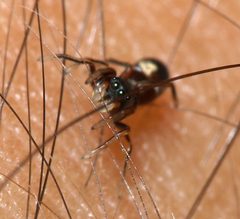
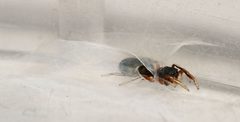
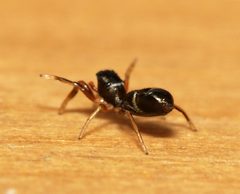
Synageles venator is a small ant-mimicking jumping spider in the Salticidae. Females reach approximately 4 mm in length, with males slightly smaller. The exhibits striking myrmecomorphy—mimicking ants in appearance, movement, and . It holds its second pair of legs raised like and moves with rapid, halting urgency characteristic of ants. This mimicry provides protection from that have learned to avoid ants due to their chemical defenses.
Pronunciation
How to pronounce Synageles venator: /sɪˈnædʒəˌliːz vəˈneɪtər/
These audio files are automatically generated. While they are not always 100% accurate, they are a good starting point.
Identification
Distinguished from the similar ant-mimicking jumping spider Leptorchestes berolinensis by the presence of a white line on the back of the . Distinguished from the related Peckhamia by shape: Synageles has a less convex cephalic area and is not sharply declivous behind the third row of . The combination of small size, rapid -like movement, and raised second pair of legs held like is diagnostic for ant-mimic salticids in this group. Close examination of eye arrangement and carapace profile may be needed to separate from .
Images
Appearance
Small jumping spider with pronounced -like body form. Females approximately 4 mm, males slightly smaller. features a distinctive white line on the back of the . Body shape and proportions closely resemble those of small ants, with relatively narrow and elongated appearance compared to typical salticids. The second pair of legs is often held raised and forward, mimicking ant .
Habitat
Found in open, sunny including xeric limestone prairies (glades), grasslands, and forest edges. Associated with woody vegetation including post oak (Quercus stellata) and persimmon (Diospyros virginiana). Occupies vegetation from which it can hunt and where prey are abundant.
Distribution
Palearctic region; North Africa; eastern Canada; British Columbia. In Central Europe, it is the most common -like jumping spider.
Diet
Preys on ants and other small arthropods. The -mimicking and facilitate close approach to ant prey.
Behavior
Exhibits rapid, halting movement virtually indistinguishable from that of small ants. Holds second pair of legs raised and forward, mimicking . This ant-mimicry (myrmecomorphy) is behavioral as well as morphological. When disturbed, runs continuously and rapidly, making photography and observation challenging. The mimicry has been demonstrated to protect against avian : hand-raised tits without ant experience ate the spiders readily, but avoided them after experiencing the nauseating effects of formic acid from real ants.
Ecological Role
of ants and other small arthropods. Subject of protective mimicry system involving of chemically defended . Serves as prey for predators that have not learned ant avoidance.
Human Relevance
Subject of behavioral and evolutionary studies on protective mimicry. No economic or medical significance.
Similar Taxa
- Leptorchestes berolinensisSimilar ant-mimicking jumping spider; distinguished by lacking the white line on the back of the present in S. venator
- Peckhamia spp.Related -mimic ; distinguished by more convex cephalic area of and sharply declivous profile behind the third row of
More Details
Mimicry effectiveness
The mimicry is effective enough to fool human observers at close range; the spiders are often mistaken for ants until careful examination reveals eight legs and spider arrangement.
Taxonomic note
The Synageles was revised by Cutler (1988), who distinguished American from related genera based on and arrangement.