
Synageles noxiosus
(Hentz, 1850)
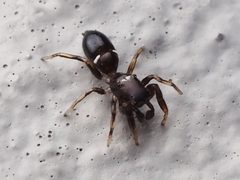
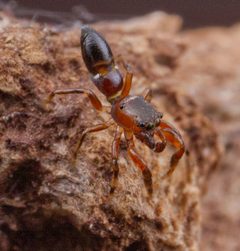
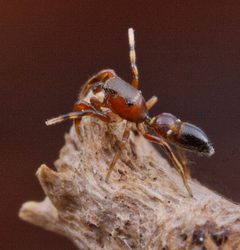
Synageles noxiosus is a of jumping spider in the Salticidae. It is found in North America and the Bahama Islands. The species belongs to a of ant-mimicking jumping spiders, characterized by their distinctive and that allows them to resemble ants.
Pronunciation
How to pronounce Synageles noxiosus: /sɪˈneɪ.dʒɪˌliːz nɒkˈsiː.oʊ.səs/
These audio files are automatically generated. While they are not always 100% accurate, they are a good starting point.
Identification
Members of Synageles can be distinguished from the related -mimicking Peckhamia by the more convex in the cephalic area and sharply declivous profile behind the third row of . Synageles noxiosus specifically may be distinguished from by geographic distribution and subtle morphological differences, though detailed diagnostic features are not extensively documented in available literature.
Images
Appearance
As a member of the -mimicking Synageles, this exhibits morphological adaptations for myrmecomorphy (ant mimicry). The is more convex in the cephalic area and sharply declivous (downward sloping) behind the third row of . The spider holds its second pair of legs aloft to create the illusion of , enhancing its resemblance to ants. Specific coloration and pattern details for S. noxiosus are not well documented in available sources.
Habitat
Distribution
North America (United States, Canada, Mexico) and the Bahama Islands.
Behavior
Exhibits -mimicking , holding the second pair of legs aloft to simulate . This myrmecomorphy is thought to provide protection from that avoid ants, and may facilitate access to ant-associated resources.
Similar Taxa
- PeckhamiaRelated of ant-mimicking jumping spiders; distinguished by shape—Peckhamia has a less convex cephalic area and less sharply declivous profile.
- Other Synageles species within the same ; S. noxiosus may be distinguished by geographic distribution and subtle morphological differences, though detailed comparative data are limited.
More Details
Taxonomic history
The was originally described by Nicholas Marcellus Hentz in 1850, making it one of the earlier described species in this -mimicking .