
Peckhamia americana
(G. W. Peckham & E. G. Peckham, 1892)
American ant-mimic jumping spider
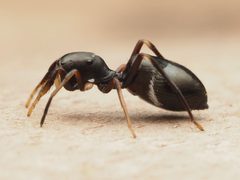
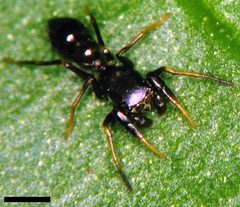
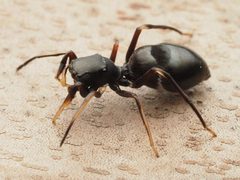
Peckhamia americana is a small jumping spider ( Salticidae) renowned for its striking -mimicry. The holds its second pair of legs aloft to simulate , creating a convincing illusion of a six-legged ant. It belongs to a group of salticids that have evolved this mimicry as a defensive strategy against that avoid ants. The spider is active and fast-moving, making it challenging to photograph or observe closely.
Pronunciation
How to pronounce Peckhamia americana: //pɛkˈheɪmiə əˌmɛrɪˈkɑːnə//
These audio files are automatically generated. While they are not always 100% accurate, they are a good starting point.
Identification
Distinguished from the related Synageles by the more convex cephalic and sharp declivity behind the third row of . The -mimicking posture—holding the second pair of legs raised to simulate —is shared with Synageles but the carapace shape differs. From true ants, distinguished by eight legs (with two held aloft appearing as six), the presence of two body segments rather than three, and large eyes characteristic of jumping spiders.
Images
Habitat
Found in dry-mesic upland deciduous forest and similar woodland . One documented observation involved an individual beaten from post oak (Quercus stellata) branches in a glade-margin setting. The appears associated with trees and shrubs in open woodland or forest edge environments.
Distribution
United States (east of the Rocky Mountains), Mexico, and Hispaniola. North American records span from at least Missouri to Georgia and New Mexico.
Seasonality
have been observed in May, suggesting spring activity. Specific details are limited.
Behavior
Exhibits rapid, continuous movement with halting, urgent locomotion that enhances its -like appearance. When disturbed or while hunting, holds the second pair of legs aloft and waves them in a manner resembling ant . This is highly effective ant-mimicry that likely provides protection from . Individuals are extremely active and reluctant to remain still, making close observation and photography difficult.
Ecological Role
Presumably a of small arthropods typical of jumping spiders. The -mimicry suggests involvement in predator-avoidance strategies within forest , though specific ecological impacts are undocumented.
Human Relevance
Of interest to arachnologists and naturalists studying -mimicry and defensive adaptations in spiders. No documented economic or medical significance.
Similar Taxa
- Synageles spp.Related salticid that also exhibit -mimicry with raised second legs; distinguished from Peckhamia by shape (less convex cephalic region, less sharply declivous behind third row)
- True ants (Formicidae)Convergent appearance due to mimicry; distinguished by eight legs (six visible), two body segments, large , and lack of elbowed
More Details
Taxonomic note
The Peckhamia was distinguished from Synageles by Cutler (1988) based on : Peckhamia has a more convex cephalic area and is sharply declivous behind the third row of .
Behavioral observation
One observer noted the effectiveness of the -mimicry: the spider's movement was described as 'too urgent' and 'too halting' for a true ant, yet the overall impression was convincing enough that initial dismissal as 'just an ant' was tempting.
Sources and further reading
- BugGuide
- Wikipedia
- GBIF taxonomy match
- iNaturalist taxon
- Catalogue of Life
- mimicry | Beetles In The Bush
- Deerly departed: food for flesh-recycling carrion beetles - Margined carrion beetle, Oiceoptoma noveboracense, and American carrion beetle, Necrophila americana — Bug of the Week
- Unwelcome guests in Hawai’i: American cockroach, Periplaneta americana, German cockroach, Blattella germanica, and Western yellowjacket, Vespula pensylvanica — Bug of the Week
- As a Watershed is Urbanized, Damselflies Show Declines
- Silphidae | Beetles In The Bush
- Bug Eric: A Jumping Spider, Tutelina similis