
Tutelina
Simon, 1901
Species Guides
4- Tutelina elegans(Thin-spined Jumping Spider)
- Tutelina formicaria
- Tutelina harti(Hart's Jumping Spider)
- Tutelina similis(Thick-spined Jumping Spider)
Tutelina is a of jumping spiders (Salticidae) first described by Eugène Simon in 1901. It contains six distributed across North and South America, with most species found in the United States and Canada. Members of this genus are small but visually distinctive, with some species exhibiting metallic coloration and -mimicking . The genus includes both and , with at least one documented as an ant specialist.
Pronunciation
How to pronounce Tutelina: //tjuːtɛˈliːnə//
These audio files are automatically generated. While they are not always 100% accurate, they are a good starting point.
Identification
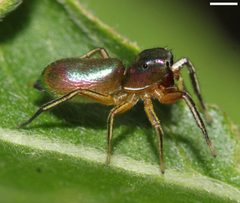
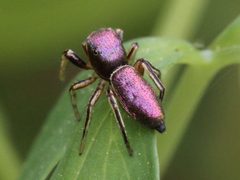
The combination of small size, jumping spider arrangement (large eyes), and distinctive coloration in males helps distinguish Tutelina from other small salticids. The 'eyebrow' markings behind the anterior eyes in T. similis males are a notable feature. Metallic coloration in some (noted in T. elegans) may aid identification. -mimicking and front leg waving, when observed, can suggest T. similis specifically. Distinguishing between species within the requires examination of pedipalp structure and coloration patterns.
Images
Appearance
Small jumping spiders, with body lengths ranging from 4.0–5.0 mm. Males of T. similis have that are black on the outer half with a fringe of long white hairs on the inner half. Some display metallic coloration. is present: males and females differ in appearance, with females slightly larger. T. similis males have short black lines on the immediately behind the , creating an 'eyebrow' appearance.
Habitat
Found in wooded areas, understory vegetation 3–4 feet above ground, and sunlit patches where deciduous opens. Documented in pitcher plant seedheads in Maine, on mailboxes in rural Massachusetts, and in sagebrush in Utah. Occurs in both forested and semi-open environments.
Distribution
North and South America. occur in Ecuador, Guyana, Canada, and the United States. T. similis and T. harti are transcontinental in Canada and range east of the Rocky Mountains in the U.S. to at least Georgia and New Mexico. T. elegans, T. formicaria, and T. similis occur in the USA; T. harti in USA and Canada; T. purpurina in Guyana; T. rosenbergi in Ecuador.
Seasonality
Peak activity in June, based on overwhelming number of records from that month. This timing corresponds with maturation and peak insect activity in sunlit patches.
Diet
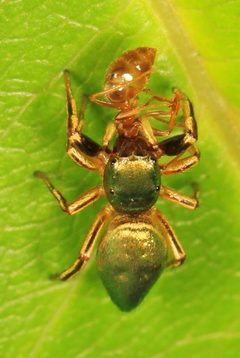
on small insects including flies, , and bees. At least one Utah of T. similis is a predator, mimicking ants in color and while hunting them. Captive specimens have been observed accepting fruit flies.
Behavior
Active hunters that prowl vegetation rather than building webs. T. similis exhibits -mimicry in some : waving front legs in the manner of ant while prowling over sagebrush. When hunting ants, observed to deliver one bite then retreat to a safe distance while the prey is paralyzed. Described as patient and cautious hunters.
Ecological Role
of small insects and other arthropods. - may influence local ant dynamics. Contributes to pest control in gardens and natural areas.
Human Relevance
Beneficial to gardeners and homeowners as of pest insects. Frequently encountered in human-modified environments including mailboxes and residential yards. Some enthusiasts keep and breed them in captivity. Their distinctive appearance and make them accessible subjects for public appreciation of spiders.
Similar Taxa
- Other small Salticidae generaTutelina shares general body plan with many small jumping spiders; distinguished by specific coloration, 'eyebrow' markings in T. similis males, and -mimicking in some
- Ants-mimicking of T. similis resemble ants in color and front-leg movement ; distinguished by arrangement and structure upon close inspection
More Details
Ant mimicry specialization
A Utah of T. similis represents a documented case of , where the spider visually and behaviorally mimics its prey to facilitate hunting. This is not universal across the or even all populations of T. similis.
Unusual microhabitats
Documented occurrences include pitcher plant (Sarracenia purpurea) seedheads in Maine and rural mailboxes in Massachusetts, indicating ecological flexibility.