
Tutelina similis
(Banks, 1895)
Thick-spined Jumping Spider
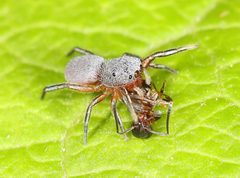
Tutelina similis is a small jumping spider in the Salticidae, native to North America. Males measure 4.0–5.0 mm in body length and display striking black and white facial markings, including distinctive "eyebrow" lines behind the . The exhibits pronounced , with females being slightly larger and differently patterned. It is primarily active in June, when mature and hunt in sunlit patches of understory vegetation. Some have been documented as -mimics and ant .

Pronunciation
How to pronounce Tutelina similis: /tjuːtəˈliːnə ˈsɪmɪlɪs/
These audio files are automatically generated. While they are not always 100% accurate, they are a good starting point.
Identification
Males are recognized by bold black with white hair fringes on the inner half, short black "eyebrow" lines on the behind the large , and overall compact build. Females are slightly larger with different coloration. The combination of facial patterning and pedipalp structure distinguishes it from other Tutelina and sympatric salticids.
Images
Habitat
Understory vegetation in deciduous and mixed woodlands, often 3–4 feet above ground in sunlit gaps. Documented in wooded ravines, rural mailboxes, and pitcher plant seedheads in boggy areas.
Distribution
Transcontinental in Canada; in the United States, found east of the Rocky Mountains from at least Georgia and New Mexico northward. Records include Massachusetts, Maine, Ontario, Utah, and New Mexico.
Seasonality
mature and are most frequently observed in June; the majority of citizen science records cluster in this month.
Diet
Behavior
hunter that prowls vegetation rather than building webs. Some exhibit -mimicry, including color matching and behavioral imitation of ant -waving. Hunting strategy involves patient stalking; when attacking ants, individuals deliver a single bite then retreat to wait for paralysis.
Ecological Role
in forest understory ; - may help regulate ant populations in sagebrush .
Human Relevance
Beneficial in gardens and natural areas; harmless to humans due to small size. Subject of citizen science documentation and arachnological interest.
Similar Taxa
- Tutelina elegansCongeneric jumping spider with metallic coloration; distinguished by different structure and body patterning.
- Other SalticidaeFacial markings and separate T. similis from most sympatric jumpers; -mimic in some further aids recognition.