
Tutelina elegans
(Hentz, 1846)
Thin-spined Jumping Spider
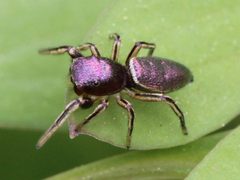
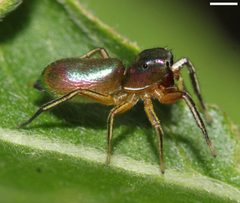
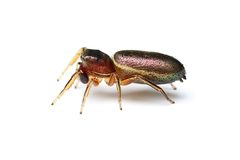
Tutelina elegans is a small jumping spider (Salticidae) native to North America, recognized for its striking metallic coloration. The name refers to its elegant bronze-green to -red appearance. It exhibits pronounced , with males displaying more vivid coloration including iridescent purple abdominal markings and orange leg segments. Body length ranges from 4-6 mm.
Pronunciation
How to pronounce Tutelina elegans: //tjuːtɛˈliːnə ɛˈleɪɡænz//
These audio files are automatically generated. While they are not always 100% accurate, they are a good starting point.
Identification
Distinguished from by combination of small size (4-6 mm), metallic bronze-green to -red coloration, and specific leg patterning. Males identifiable by iridescent purple spot at , orange legs with darkening tips, and prominent tufts of yellow and black hairs on . Females distinguished by more subdued bronze-green coloration, yellow legs with dark stripes, and relatively longer fourth legs. Distinguished from Tutelina similis by coloration details: T. similis males have black outer half of with white hair fringe and 'eyebrow' markings of short black lines behind anterior , which T. elegans lacks.
Images
Appearance
Small spider with metallic bronze-green to -red coloration that shifts with lighting. Females: approximately two-thirds as wide as long with nearly straight parallel sides; oval opisthosoma nearly twice as long as wide; legs yellow with dark longitudinal stripes, front dark brown. Males: more brightly colored than females; legs orange darkening distally with fine dark stripes, front tibiae with dark brown tips and long brown hairs on inner and upper surfaces; orange with darker tips; cephalothorax sides and orange with white line over ; upper cephalothorax and covered with greenish-yellow ; two forward-pointing tufts of yellow and black hairs between middle and lateral ; iridescent purple spot at posterior abdomen; abdomen underside green, sternum and coxae orange. slender with short strongly curved inward-pointing claws; male chelicerae slightly longer and somewhat hollowed on inner side. in leg proportions: males have first pair of legs much longer and larger than others; females have fourth legs longest.
Distribution
North America: recorded from Canada and the United States. GBIF records indicate presence in Vermont and other US states.
Similar Taxa
- Tutelina similisSimilar size range and general habitus, but T. similis males have black outer half of with white hair fringe and distinctive 'eyebrow' markings (short black lines behind ) not present in T. elegans; T. similis also shows -mimicking in some which has not been documented for T. elegans
More Details
Etymology
name elegans is Latin for 'elegant' or 'refined', referring to the attractive metallic appearance of this spider.
Type species
Tutelina elegans is the type of the Tutelina.
Sources and further reading
- BugGuide
- Wikipedia
- GBIF taxonomy match
- iNaturalist taxon
- NCBI Taxonomy
- Catalogue of Life
- Bring on the Tourists! | Bug Squad
- More Nematodes in Outer Space? | Bug Squad
- Showcasing Animal and Plant Parasitic Nematodes | Bug Squad
- Don't Miss the Nematode Collection at UC Davis Biodiversity Museum Day Feb. 10 | Bug Squad
- UC Davis Speaker: Fatma Kaplan, A Go-Getter and Maybe a Genius | Bug Squad
- Bug Eric: A Jumping Spider, Tutelina similis