
Hogna osceola
(Gertsch & Wallace, 1937)
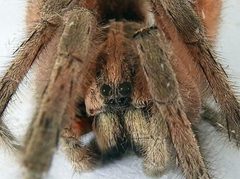
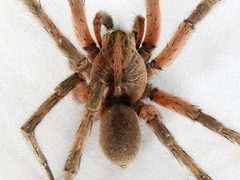
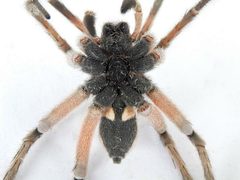
Hogna osceola is a of wolf spider in the Lycosidae, first described by Gertsch and Wallace in 1937. It is a burrow-living wolf spider found in sandy of western Texas and adjacent regions. Like other members of the Hogna, it exhibits the characteristic arrangement of wolf spiders with enlarged eyes that produce eyeshine visible at night when illuminated. The species appears to be associated with sand dune systems, where individuals construct silk-lined burrows.
Pronunciation
How to pronounce Hogna osceola: /ˈhɒɡnə ɒsˈsiːələ/
These audio files are automatically generated. While they are not always 100% accurate, they are a good starting point.
Images
Habitat
Sand dune systems and sandy areas in arid regions. The constructs silk-lined burrows in sandy substrate, with burrow entrances often marked by debris or silk turrets.
Distribution
United States; specifically recorded from western Texas and potentially adjacent areas of New Mexico. Distribution appears centered on sand dune systems in the Trans-Pecos region.
Behavior
Nocturnally active, with individuals leaving burrows to forage. The enlarged produce conspicuous eyeshine when illuminated at night, making individuals detectable with headlamps or flashlights. Burrow construction involves excavation using and front legs, with silk lining the vertical shaft.
Similar Taxa
- Hogna carolinensisSimilar large size and burrowing habit in sandy ; distinguished by geographic distribution and subtle morphological differences in genitalia and coloration patterns.
- Geolycosa speciesAlso burrowing wolf spiders with similar preferences; Geolycosa has a more steeply elevated and different burrow architecture with more prominent turrets.
- Arctosa littoralisShares sandy littoral and eyeshine ; Arctosa has a more flattened body profile and different arrangement proportions, and typically occupies beach and riverside habitats rather than inland dunes.
More Details
Taxonomic note
The was described by Gertsch and Wallace in 1937. It is one of numerous Hogna species in North America, many of which require careful examination of genitalia for definitive identification.
Field observation method
Best detected at night using headlamps or flashlights to locate eyeshine from the reflective tapetum of the . Daytime detection requires searching for burrow entrances in sandy substrates.