
Geolycosa missouriensis
(Banks, 1895)
Missouri Burrowing Wolf Spider, Burrowing Wolf Spider, Missouri Earth Spider, Missouri Wolf Spider
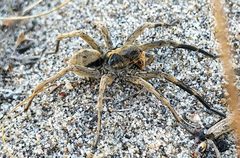
Geolycosa missouriensis is a large wolf spider native to the Great Plains of North America. It is a burrowing that spends most of its life in deep, silk-lined vertical burrows, emerging primarily to hunt or mate. The exhibits in size, with females reaching approximately 21 mm in body length and males 15–18 mm. Unlike wandering wolf spiders, this species employs an ambush strategy, detecting prey through ground vibrations from within its burrow.
Pronunciation
How to pronounce Geolycosa missouriensis: /ˌdʒiː.oʊ.laɪˈkoʊ.sə ˌmɪ.zəˈriː.ɛn.sɪs/
These audio files are automatically generated. While they are not always 100% accurate, they are a good starting point.
Identification
Distinguished from other Lycosidae by the steeply elevated creating a pronounced slope toward the rear. Separated from Hogna by smaller average size and burrowing . Differs from Arctosa littoralis (another burrowing wolf spider) by geographic range—G. missouriensis is primarily a Great Plains rather than coastal or riparian. Burrow presence with silk-and-debris turret confirms identification in .
Images
Appearance
Large, robust wolf spider with sexually dimorphic size. Females approximately 21 mm body length; males 15–18 mm with leg span up to 34 mm. Front legs stout and modified for digging. distinctly elevated anteriorly, sloping posteriorly—this profile separates Geolycosa from other wolf spider . Powerful used for burrow excavation. Coloration and markings variable among individuals.
Habitat
Open areas with sandy, well-drained soil and sparse ground litter. Burrows constructed in substrates that allow excavation; soil type critical for burrow maintenance. Turret at burrow entrance constructed from silk mixed with collected debris and plant material.
Distribution
Great Plains of North America, from southern Canada (Alberta, Manitoba) to Texas, east to New York and west to Utah and Arizona. Core range centered on prairie and plains .
Seasonality
Most active in summer. mature in late summer to early autumn (August–October), when males wander seeking females. Females oviposit May–June following year.
Life Cycle
Apparently . Half-grown individuals overwinter in burrows exceeding 1 meter depth; summer burrows average 20–25 cm. Burrow depth and diameter increase with spider growth. Mating occurs in late summer/early autumn. Females construct spherical sacs carried attached to , sunned at burrow entrance on warm days. Spiderlings emerge and establish burrows near maternal site, resulting in localized .
Behavior
Primarily ; spends majority of life within burrow. Hunts by ambush from burrow entrance, detecting approaching prey through substrate vibrations. Constructs and maintains silk-lined vertical burrow throughout life, enlarging as body size increases. Males leave burrows to wander in search of females during breeding season. Females exhibit maternal care: carrying sac and later spiderlings.
Ecological Role
in soil and ground . structure influenced by limited of offspring, creating localized patches of high . Burrowing activity may contribute to soil aeration in sandy .
Human Relevance
Occasionally encountered during outdoor activities in suitable . Not medically significant. Of interest to arachnologists and naturalists for distinctive burrowing and adaptations.
Similar Taxa
- Arctosa littoralisAlso a burrowing wolf spider, but primarily coastal, riparian, and beach ; ranges overlap partially but A. littoralis favors sandier, moister substrates near water.
- Hogna spp.Larger wandering wolf spiders that do not construct permanent burrows; elevated profile absent; active hunters rather than ambush .
More Details
Burrow structure
Burrows vertical, silk-lined throughout, with turret of silk and debris at entrance. Depth varies seasonally: deeper in winter (over 1 m), shallower in summer (20–25 cm).
Detection methods
Burrows difficult to locate; search for circular entrance holes with debris turrets in open sandy areas. Night searching with headlamp reveals shine in wandering males.