
Clubiona pygmaea
Banks, 1892
Pygmy Sac Spider
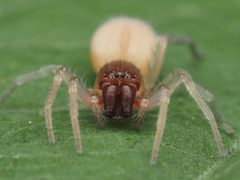
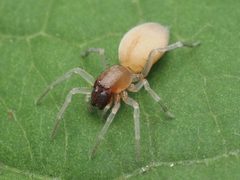
Clubiona pygmaea is a of sac spider in the Clubionidae, first described by Nathan Banks in 1892. It is distributed across the United States and Canada. As a member of the sac spider family, it likely constructs silken retreats rather than prey-capture webs and hunts actively for small prey. The species epithet "pygmaea" refers to its small size relative to other members of the .
Pronunciation
How to pronounce Clubiona pygmaea: /kluːˈbaɪoʊnə pɪɡˈmiːə/
These audio files are automatically generated. While they are not always 100% accurate, they are a good starting point.
Identification
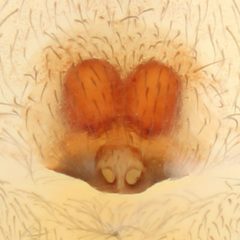
Clubiona pygmaea can be distinguished from the superficially similar longlegged sac spiders in the Cheiracanthium ( Eutichuridae) by the presence of a distinct groove in the center of the and a tuft of curved setae on the front edge of the —features that Cheiracanthium lacks. Within the genus Clubiona, C. pygmaea is notably smaller than most , as reflected in its name.
Images
Habitat
Found in forested and wooded . Based on observations of , likely occupies spaces under loose bark, within crevices, and among leaf litter. Less frequently encountered indoors compared to Cheiracanthium .
Distribution
United States and Canada. Specific state and provincial records are sparse in the available literature.
Behavior
As a sac spider, constructs silken retreats for resting and -laying rather than webs for prey capture. Hunts actively on foot for small prey.
Ecological Role
of small insects and other arthropods in forest floor and understory . Serves as prey for spider wasps including Priocnemis minorata, which has been documented parasitizing other Clubiona .
Human Relevance
Not commonly encountered indoors. No documented medical significance; not known to be dangerously venomous. Bites, if they occur, would likely result in minor localized effects.
Similar Taxa
- Cheiracanthium spp.Formerly classified in Clubionidae, these longlegged sac spiders are frequently mistaken for Clubiona. They lack the groove and abdominal setal tuft present in Clubiona, and are more commonly found indoors.
- Clubiona spp.Other Clubiona are larger; C. pygmaea is distinguished by its notably small body size.
Sources and further reading
- BugGuide
- Wikipedia
- GBIF taxonomy match
- iNaturalist taxon
- NCBI Taxonomy
- Catalogue of Life
- Tiny Insect, Big Questions: Is the World's Smallest Dragonfly Splitting Into Two Species?
- Bug Eric: One Night, One House, Seventeen Spider Species
- A suitable ode to Warren Knaus | Beetles In The Bush
- Bug Eric: Spider Sunday: Longlegged Sac Spiders
- Bug Eric: Priocnemis minorata
- Bug Eric: Spider Sunday: Coras