
Clubiona pallidula
(Clerck, 1757)
European Sac Spider
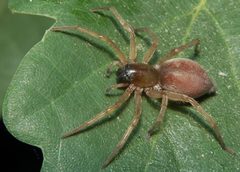
Clubiona pallidula is a of sac spider in the Clubionidae. It is native to Europe, the Caucasus, Russia (extending to the Far East), and Central Asia, and has been introduced to North America. The species has been the subject of detailed morphological studies examining its genital anatomy and copulatory mechanics. Unlike some related spiders frequently found indoors, this species is primarily encountered in outdoor .

Pronunciation
How to pronounce Clubiona pallidula: //klʊˈbaɪ.oʊ.nə ˌpælɪˈdʌlə//
These audio files are automatically generated. While they are not always 100% accurate, they are a good starting point.
Identification
Distinguished from the superficially similar longlegged sac spiders ( Cheiracanthium, Eutichuridae) by possessing a distinct groove in the center of the and a tuft of curved setae on the front edge of the —features absent in Cheiracanthium. The genus Clubiona is characterized by these traits, though -level identification requires examination of genitalia.
Images
Habitat
Forested and natural outdoor ; not typically associated with indoor environments unlike some related sac spider .
Distribution
Native to Europe, the Caucasus, Russia (Europe to Far East), and Central Asia. Introduced to North America.
Behavior
Constructs silken sac-like retreats for resting during the day; hunts actively on foot without building webs for prey capture.
Human Relevance
Less commonly encountered indoors compared to other sac spider ; not considered a significant indoor pest.
Similar Taxa
- Cheiracanthium spp.Formerly classified in Clubionidae and similar in general appearance, but lacks the central groove and abdominal setal tuft present in Clubiona; also more frequently found indoors.
Sources and further reading
- BugGuide
- Wikipedia
- GBIF taxonomy match
- iNaturalist taxon
- NCBI Taxonomy
- Catalogue of Life
- Bug Eric: One Night, One House, Seventeen Spider Species
- Bug Eric: Spider Sunday: Longlegged Sac Spiders
- Bug Eric: Priocnemis minorata
- How Ants Do Battle: Toxic Sprays, Thick Armor, Overwhelming Numbers, and More
- Bug Eric: Spider Sunday: Coras
- ESA Insect Macrophotography Workshop | Beetles In The Bush
- Genital morphology and copulatory mechanics in Anyphaena accentuata (Anyphaenidae) and Clubiona pallidula (Clubionidae: Araneae)