
Microtrombidiidae
micro velvet mites
Subfamily Guides
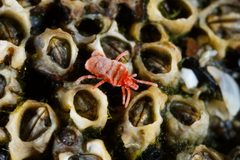
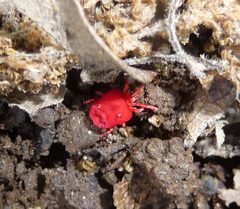
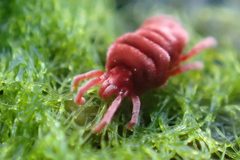
3Microtrombidiidae is a of mites in the order Trombidiformes, commonly known as micro velvet mites. The family contains approximately five and seven described , including Ettmulleria, Eutrombidium, Holcotrombidium, Microtrombidium, and Platytrombidium. Modern taxonomic studies recognize Eutrombidiidae as the Eutrombidiinae within Microtrombidiidae. Members of this family exhibit parasitic larval stages and free-living post-larval instars.
Pronunciation
How to pronounce Microtrombidiidae: /ˌmaɪkroʊˌtrɒmbɪˈdaɪɪdiː/
These audio files are automatically generated. While they are not always 100% accurate, they are a good starting point.
Identification
Microtrombidiidae can be distinguished from related by larval characteristics including the structure of sensillary setae on the and the number of adoral setae. Some , such as Troglotrombidium, exhibit highly modified claws on III and absence of . Larvae attach to membranous areas rather than , contrasting with some related erythraeid mites.
Images
Habitat
include subterranean such as caves, where troglobitic occur. Some species have been collected from field environments with laboratory rearing successful under varied thermal and light conditions. Specific microhabitat preferences vary by and species.
Distribution
Documented from Australia, Turkey (Western Taurus Mountains), Tasmania, and Scandinavia (Denmark, Norway, Sweden). The Gonothrombium, previously known from Africa and Romania, has been recorded from Turkey. The Australian Eutrombidium australiense appears distributed across almost all of mainland Australia.
Host Associations
- Dolichopoda lycia - cave cricket (Orthoptera: Rhaphidophoridae), for Troglotrombidium dolichopodum larvae
- Apteropanorpa tasmanica - wingless (Mecoptera: ), for Willungella rufusanus larvae; first record of mecopteran host for microtrombidiine mites
- Phlebotomus alexandri - (Diptera: Psychodidae), for Biskratrombium persicum
- Australian grasshoppers - at least 248 across Morabinae, Pyrgomorphinae, Oxyinae, Catantopinae, and Acridinae; primary attachment sites are insertion of leg III and
- Collembola - cave springtails (Paronellidae), first reported record for
Life Cycle
includes , larva, deutonymph, and stages. Larvae are ectoparasitic, while post-larval instars are free-living. Egg incubation duration is temperature-dependent, with lower temperatures extending development time. In Platytrombidium fasciatum, morphological variability in larvae is influenced by breeding temperature and light/dark cycle.
Behavior
Larval ectoparasitism is the primary behavioral mode. Larvae attach preferentially to membranous areas of rather than . Individual hosts may support one to four mites, though most carry one or two. Attachment site specificity varies: Willungella rufusanus larvae attach predominantly to host , while related erythraeid mites attach more evenly across the body.
Ecological Role
Larval of diverse including orthopterans, mecopterans, dipterans, and collembolans. Role in subterranean includes documented host- interactions in cave .
Similar Taxa
- ErythraeidaeRelated of parasitengone mites with larval ectoparasitic stages; distinguished by larval attachment preferences (Erythraeidae often attach to , Microtrombidiidae to membranous areas)
- TrombidiidaeRelated velvet mite ; Microtrombidiidae are smaller and exhibit different larval morphological characteristics including sensillary setae structure
More Details
Taxonomic Note
The Eutrombidiidae is now treated as Eutrombidiinae within Microtrombidiidae in modern classifications. The tribe Hexathrombiini is recognized within Eutrombidiinae.
Morphological Plasticity
Laboratory studies demonstrate significant morphological variability in larval traits under different environmental conditions, with 40 measurable traits in Platytrombidium fasciatum showing variability beyond previously known characteristics.
Sources and further reading
- BugGuide
- Wikipedia
- GBIF taxonomy match
- iNaturalist taxon
- NCBI Taxonomy
- Catalogue of Life
- Description of the larva of Enemothrombium bifoliosum (Canestrini, 1884) (Acari: Parasitengona: Microtrombidiidae), redescription of adult and deutonymph with comments on the phylogeny of Microtrombidiidae
- A subterranean new genus and species of Eutrombidiinae (Trombidiformes: Microtrombidiidae) from Turkey
- Different breeding conditions affect the morphological variability in larvae of Platytrombidium fasciatum (Trombidiformes: Microtrombidiidae)
- Figure 2 from: Oliveira MPA, Bernardi LFO, Zeppelini D, Ferreira RL (2016) First report of cave springtail (Collembola, Paronellidae) parasitized by mite (Parasitengona, Microtrombidiidae). Subterranean Biology 17: 133-139. https://doi.org/10.3897/subtbiol.17.8451
- Morphological and molecular characteristics of Milandanielia intermedia (Feider, 1950) (Trombidiformes: Microtrombidiidae) with data on its biology and ecology
- A review of Gonothrombium Feider, 1950 (Actinotrichida: Microtrombidiidae) with description of a new species from Turkey
- Host Relations and Distribution of the Australian Species of Eutrombidium (Acarina, Microtrombidiidae), a Parasite of Grasshoppers
- A Redescription ofEchinothrombium spinosum(Canestrini, 1885) (Acari: Actinotrichida: Prostigmata: Microtrombidiidae) with Notes on Biology and Life Cycle
- Two parasitic mite species on Phlebotominae sand flies (Diptera: Psychodidae) from Türkiye: Biskratrombium persicum (Microtrombidiidae) and Eustigmaeus johnstoni (Stigmaeidae)
- Parasitism of Apteropanorpa tasmanica Carpenter (Mecoptera: Apteropanorpidae) by larval Leptus agrotis Southcott (Acari: Erythraeidae) and Willungella rufusanus sp. nov. (Acari: Microtrombidiidae)
- An insight into the tribe Hexathrombiini (Actinotrichida: Trombidioidea, Microtrombidiidae, Eutrombidiinae) with new data on host-parasite interaction