
Reduviidae
Latreille, 1807
Assassin Bugs, Ambush Bugs, Kissing Bugs, Wheel Bugs, Thread-legged Bugs, Bee Assassins, Millipede Assassins, Masked Hunters
Subfamily Guides
11- Bactrodinae
- Ectrichodiinae(Millipede Assassin Bugs)
- Emesinae(Thread-legged Bugs)
- Harpactorinae(Assassin bugs)
- Microtominae
- Peiratinae(corsairs)
- Phymatinae(Ambush Bugs)
- Reduviinae
- Saicinae
is a large of true bugs (Hemiptera: Heteroptera) comprising approximately 7,000 described across more than 20 . The family is predominantly terrestrial and predatory, with members employing diverse hunting strategies including ambush , active pursuit, and specialized prey capture using modified forelegs or sticky secretions. A notable exception is the subfamily Triatominae, whose members are of vertebrates and of . Most species possess a distinctive narrow neck, sturdy body, and curved that fits into a stridulatory groove on the , producing sound when rubbed against ridges. The family exhibits remarkable morphological diversity, with body sizes ranging from 12 to 36 mm and coloration spanning cryptic browns and blacks to aposematic reds, oranges, and metallic blues.
Pronunciation
How to pronounce Reduviidae: /rɛˌdjuːviˈaɪdiː/
These audio files are automatically generated. While they are not always 100% accurate, they are a good starting point.
Identification
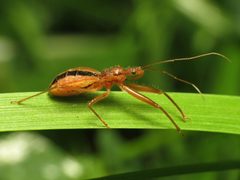
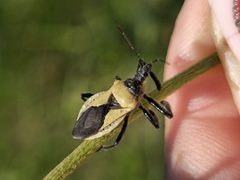
Most are recognizable by a relatively narrow neck connecting to , a sturdy build, and a prominent curved that rests in a groove on the . The head is typically elongated with long, segmented . Forelegs are often modified for prey capture: in Phymatinae (ambush bugs) with grasping surfaces, or bearing sticky glandular secretions in Zelus (sundew assassin bugs). Many exhibit bright aposematic coloration in red, orange, or yellow and black; others are cryptically colored in brown or black. The proboscis tip fits into a ridged prosternal groove used for stridulation. Large specimens should be handled with caution due to their ability to deliver painful defensive stabs with the proboscis.
Images
Habitat
Predatory occupy diverse terrestrial including forests, grasslands, deserts, and agricultural areas. Many are arboreal, found on foliage and flowers of trees, shrubs, and herbs. Some exhibit specialized microhabitat preferences: Phymatinae (ambush bugs) frequent flowers where they wait for ; Emesinae (thread-legged bugs) inhabit spider webs; Ectrichodiinae ( assassins) occur in leaf litter and under stones; Reduvius personatus (masked hunter) is found in human dwellings. Triatominae (kissing bugs) occupy vertebrate nests and roosts, including bat caves and human habitations.
Distribution
distribution with highest diversity in tropical and subtropical regions. The occurs on all continents except Antarctica, with approximately 500 in southern Africa alone. The Zelus is widespread across the Americas from southern Canada to Argentina. Triatominae are predominantly Neotropical, with concentrated in Central and South America. The genus Reduvius is primarily distributed in arid and semi-arid regions of the Afrotropical, Oriental, and Palearctic regions, with only three New World species plus the introduced cosmopolitan R. personatus.
Diet
Most are exclusive of other arthropods, using extraoral digestion: saliva containing paralytic toxins and digestive is injected through the to liquefy prey tissues, which are then imbibed. Prey includes insects, spiders, and other small . Some exhibit specialized prey preferences: Ectrichodiinae feed on millipedes; certain Harpactorinae prey on ants; Apiomerus (bee assassins) capture bees and other flower-visiting insects. The subfamily Triatominae is exceptional, being and feeding exclusively on vertebrate blood.
Life Cycle
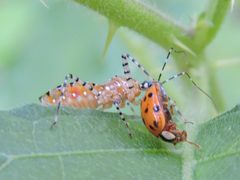
Development is hemimetabolous with five nymphal instars. are laid in clusters, sometimes covered with sticky secretions that repel and provide nymphs with material for camouflage. Nymphs resemble smaller, wingless and undergo progressive development through instars, with wing pads becoming evident in later stages. Some exhibit : nymphs of Zelus hatch from eggs coated with sticky material produced by maternal glands, which they use to coat their forelegs for prey capture. time varies with latitude; multiple generations occur annually in tropical regions, while temperate species may have one or two generations with winter in the egg stage.
Behavior
Predatory varies by : active pursuit, sit-and-wait ambush, or specialized trap using sticky forelegs. Many use stridulation (sound production by rubbing the against prosternal ridges) as a defensive behavior when disturbed. When harassed, many species deliver painful defensive stabs with the proboscis, injecting venom or digestive fluids. Nymphs of several species practice debris-carrying camouflage, covering themselves with dust, prey remains, or other materials; Reduvius personatus is notable for this behavior. Death feigning, nodding, and spitting have been reported in some species. Mating involves complex courtship behaviors, with male genital glandular areas potentially functioning in mate recognition or stimulation.
Ecological Role
function as important in terrestrial , contributing to of other arthropods. Some are significant biocontrol agents in agricultural settings, preying on pest insects such as caterpillars, leafhoppers, stink bugs, and . However, their also includes beneficial insects such as . Triatominae occupy a unique ecological role as of , the causative agent of , affecting human and wildlife health. The Emesinae has a commensal or kleptoparasitic relationship with spiders, inhabiting their webs.
Human Relevance
Beneficial aspects include on agricultural and household pests; some are deliberately maintained for pest control. Reduvius personatus is occasionally bred as a pet and for control. Medical importance is predominantly negative due to Triatominae: kissing bugs transmit (), causing approximately 12,000 deaths annually. Triatoma rubrofasciata and related species bite sleeping humans around lips and . Defensive bites from large predatory species are medically significant due to intense pain and potential secondary , though not typically life-threatening. Research interest exists in reduviid venom compounds for potential insecticidal and antibacterial applications.
Similar Taxa
- NabidaeDamsel bugs share predatory habits and forelegs with , but lack the distinctive narrow neck and prosternal stridulatory groove; they are generally smaller and more slender with less robust .
- PhymatidaeFormerly recognized as a separate , ambush bugs are now classified within ( Phymatinae); historical literature may treat them as distinct.
- CimicidaeBed bugs are also Heteroptera but are dorsoventrally flattened, wingless, and lack the narrow neck and forelegs of ; they do not possess a curved for .
Sources and further reading
- BugGuide
- Wikipedia
- GBIF taxonomy match
- iNaturalist taxon
- NCBI Taxonomy
- Catalogue of Life
- Name That Bug! | Bug Squad
- A pair of pretty assassins: Assassin bugs, Reduviidae, in the rainforest — Bug of the Week
- Reduviidae | Beetles In The Bush | Page 3
- Reduviidae | Beetles In The Bush | Page 2
- Bug Eric: Sundew Assassin Bugs: Zelus
- As many as 24 new species of assassin bugs | Blog
- Biological, behavioural and morphological tools in the biosystematics of Reduviidae (Insecta—Heteroptera—Reduviidae)
- Glandular areas associated with the male genitalia in Triatoma rubrofasciata (Triatominae, Reduviidae, Hemiptera) and other Reduviidae
- Chemosensory and behavioural adaptations for Haematophagy in Triatomine Bugs (Heteroptera : Reduviidae)
- Blood Temperature and Feeding Behavior in Triatoma infestans (Heteroptera: Reduviidae)
- Reduvius frommeri, a new species of Reduviidae from the Western United States (Hemiptera: Reduviidae), with a synopsis of the Nearctic species of Reduvius Fabricius
- Wheel Bug, Arilus cristatus (Linnaeus) (Insecta: Hemiptera: Reduviidae)
- New records of Reduviidae (Hemiptera: Heteroptera) from Costa Rica, Ecuador, French Guiana, Paraguay, and Peru
- Laboratory culture of Triatoma sanguisuga (Hemiptera: Reduviidae) by supplementation with Drosophila artificial hemolymph media.