
Reduvius
Fabricius, 1775
Species Guides
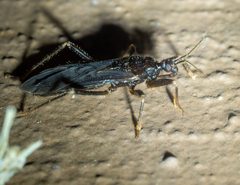
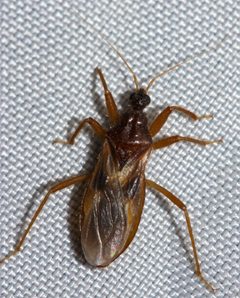
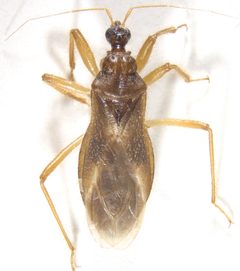
4Reduvius is a large of assassin bugs ( Reduviidae) containing approximately 197 . The genus is one of the most speciose in the assassin bug family. Most species occur in arid and semi-arid regions of the Afrotropical, Oriental, and Palearctic realms. Only three species are New World endemics, with Reduvius personatus (the masked hunter) being and introduced to the Western Nearctic. Species range from 8–22 mm in length.
Pronunciation
How to pronounce Reduvius: //rɛˈduːvi.ʊs//
These audio files are automatically generated. While they are not always 100% accurate, they are a good starting point.
Identification
The Reduvius is distinguished from other reduviid genera by general assassin bug characteristics: forelegs adapted for grasping prey, a curved segmented folded under the when not in use, and an elongate body form. Within the genus, can be differentiated by size, coloration, and body proportions. For example, R. frommeri is notably small with pale body coloration and contrasting dark head, while R. personatus is larger and uniformly dark as an .
Images
Habitat
Most Reduvius inhabit arid and semi-arid environments. The newly described R. frommeri is to a small range in the Sonoran Desert of Southern California. R. personatus occupies diverse terrestrial and microhabitats, from mammal burrows in deserts to logs in rainforests, and is frequently encountered in human dwellings.
Distribution
The has a broad global distribution with centers of diversity in the Afrotropical, Oriental, and Palearctic regions. In the Nearctic, three are , while R. personatus occurs throughout the Northern Hemisphere and has been transported to other continents through human travel and commerce. GBIF records indicate presence in Denmark, Norway, Sweden, Vermont (USA), and other US locations.
Seasonality
Reduvius personatus are most commonly observed in June and July in temperate regions. In Canada, the may extend to two years with nymphs in .
Life Cycle
R. personatus undergoes gradual with five nymphal instars. Nymphs are the stage, typically in the fifth instar, though in colder regions they may overwinter in both third and fifth instars. The sixth produces the winged . Nymphs actively cover themselves in environmental debris (lint, sawdust, dust) using sticky secretions from glandular trichomes and specialized tarsal structures for camouflage; this disguise must be renewed after each molt.
Behavior
R. personatus nymphs exhibit remarkable camouflage , accumulating debris on their bodies to resemble dust bunnies or lint. are and attracted to lights. When threatened, assassin bugs in this can stridulate by rubbing the tip of the against transverse ridges on the , producing an audible squeaking sound. They can deliver a painful defensive bite with their .
Ecological Role
Reduvius are predatory insects. R. personatus is known to prey on bed bugs (Cimicidae), swallow , silverfish, booklice, and other small arthropods. Their role in the of ( ) has been investigated but is not well established.
Human Relevance
R. personatus (masked hunter) is frequently encountered indoors, where it may be mistaken for a household pest or, conversely, welcomed as a agent for bed bugs. The can deliver a painful bite in self-defense, causing localized pain, swelling, and in some cases more severe reactions requiring medical attention. It is often confused with blood-feeding "kissing bugs" (Triatoma spp.), leading to unnecessary concern, but R. personatus is exclusively predatory on other insects and does not transmit .
Similar Taxa
- TriatomaBoth are reduviid with elongate bodies and curved . Triatoma (kissing bugs) are blood-feeders with flattened bodies and are of , while Reduvius are predatory on insects and lack the extreme body flattening of triatomines.
- ZelusBoth are reduviid assassin bugs. Zelus (sundew assassin bugs) have slender bodies with long legs and use sticky secretions on their forelegs to capture prey, whereas Reduvius species lack this sticky-trap mechanism and have different body proportions.
- MelanolestesMelanolestes picipes (Black Corsair) is another dark reduviid that enters homes and resembles R. personatus; both can deliver painful bites and are often confused by non-.
Misconceptions
R. personatus is frequently misidentified as a "kissing bug" (Triatoma spp.) or bed bug due to its and indoor occurrence. Unlike kissing bugs, it does not feed on blood and does not transmit . Its presence indoors does not necessarily indicate a bed bug , as it feeds on diverse prey and may enter homes attracted to lights or seeking shelter.
More Details
Taxonomic diversity
With approximately 197 , Reduvius is one of the largest in Reduviidae. A new species, R. frommeri, was described in 2015 from Southern California, demonstrating that species discovery continues even in well-studied regions.
Camouflage mechanism
The debris-carrying of R. personatus nymphs involves specialized anatomical structures: short and long trichomes connected to glands producing sticky substances, and a 'tarsal fan' of dense hairs on the hind legs used to apply debris. This represents a sophisticated example of active camouflage in insects.
Sources and further reading
- BugGuide
- Wikipedia
- GBIF taxonomy match
- iNaturalist taxon
- NCBI Taxonomy
- Catalogue of Life
- The Role of Macro Photography in Entomology - Buglife Blog - Buglife
- Bug Eric: True Bug Tuesday: Masked Hunter
- Bug Eric: National Moth Week Recap for Colorado Springs
- Bug Eric: Kissing Bugs
- Bug Eric: Sundew Assassin Bugs: Zelus
- Bug Eric: Indoor Insects of Autumn (part 1 of 4)
- Reduvius frommeri, a new species of Reduviidae from the Western United States (Hemiptera: Reduviidae), with a synopsis of the Nearctic species of Reduvius Fabricius
- Epizootiology of Trypanosoma Cruzi in Southwestern North America Part XI: Biology of the Genus Reduvius in North America and the Possible Relationship of Reduvius to the Epizootiology of Trypanosoma Cruzi. (Hemiptera: Reduviidae) (Kinetoplastida: Trypanosomidae)