
Ectrichodiinae
Amyot & Serville, 1843
Millipede Assassin Bugs
Genus Guides
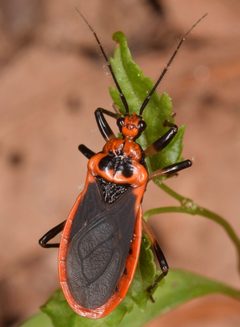
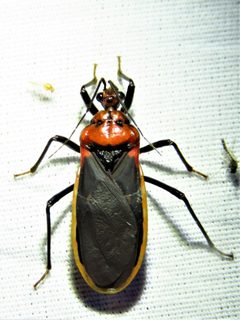
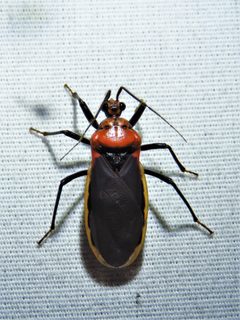
1Ectrichodiinae are a large of assassin bugs comprising more than 600 in approximately 115 . They are specialized of millipedes, capable of circumventing the noxious chemical defenses of their prey. The subfamily exhibits notable diversity in coloration, with both cryptic and aposematic patterns, including bright metallic blue, red, or yellow and black combinations. Females frequently show wing reduction and extreme .
Pronunciation
How to pronounce Ectrichodiinae: / ek.triː.kəˈdaɪ.iːˌniː/
These audio files are automatically generated. While they are not always 100% accurate, they are a good starting point.
Identification
Members of this can be recognized by their association with prey and their distinctive coloration patterns. Aposematic display bright warning colors—often metallic blue, red, or yellow combined with black—while others are cryptically colored. Ectrichodia crux, a representative species, reaches 22 mm in length with a stout body, shiny black coloration, a dull yellow bearing a distinctive incised black cross, and yellow abdominal margins; nymphs are bright red with black wing pads. is pronounced, with females often exhibiting reduced wings or aptery.
Images
Habitat
hide during the day under leaf litter, stones, or debris, emerging at night to hunt. They occupy terrestrial environments where millipedes are abundant.
Distribution
Worldwide distribution with documented occurrence in southern Africa, Rica, and Australia. The is represented across tropical and subtropical regions, though precise range boundaries for the entire subfamily remain incompletely documented.
Seasonality
activity pattern; hunting occurs at night. Specific seasonal activity patterns are not well documented for the as a whole.
Diet
on millipedes (Diplopoda). The majority of prey records are from orders Spirostreptida and Spirobolida; Polydesmida are rarely attacked. Thirteen in 12 have been documented feeding on millipedes.
Life Cycle
Nymphs are known to be bright red with black wing pads in at least some . Immatures rarely engage in solitary , instead feeding communally. Wing reduction and extreme occur in females of many species.
Behavior
Ambush that slowly approach millipedes before rapidly seizing them. Prey is subdued by inserting stylets at intersegmental on the and ventro-lateral trunk area or between the and collum, injecting saliva containing paralytic toxins and cytolytic that immobilize the and initiate external digestion. Communal is common among nymphs and groups of nymphs with ; solitary predation by immatures is rare. at millipede kills have been observed.
Ecological Role
that exploit a narrow trophic , feeding on millipedes that most other predators avoid due to chemical defenses. Their ability to circumvent benzoquinone and hydrogen cyanide defenses allows them to function as predators in -based .
Similar Taxa
- TriatominaeAlso of Reduviidae, but distinguished by blood-feeding on vertebrates rather than on millipedes; typically larger and with different .
- Other Reduviidae subfamiliesMost are or feed on other arthropods; lack the specialized -specific predatory adaptations and associated aposematic coloration of Ectrichodiinae.
Sources and further reading
- BugGuide
- Wikipedia
- iNaturalist taxon
- NCBI Taxonomy
- Catalogue of Life
- Reduviidae | Beetles In The Bush | Page 3
- Austrokatanga, gen. nov., new genus of Ectrichodiinae (Hemiptera: Heteroptera: Reduviidae) from Australia
- Phylogenetic comparative analysis supports aposematic colouration–body size association in millipede assassins (Hemiptera: Reduviidae: Ectrichodiinae)
- Toxic associations: A review of the predatory behaviors of millipede assassin bugs (Hemiptera: Reduviidae: Ectrichodiinae)
- Microstructural Adaptation for Prey Manipulation in the Millipede Assassin Bugs (Hemiptera: Reduviidae: Ectrichodiinae).
- A new species of Racelda Signoret, with taxonomical notes and a key to the males of the genus (Hemiptera, Reduviidae, Ectrichodiinae, Ectrichodiini).