
Cupedidae
Laporte, 1838
Reticulated Beetles
Genus Guides
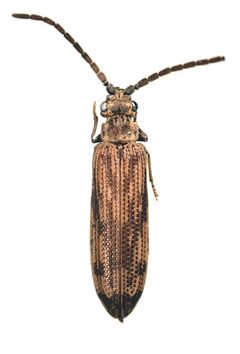
4is a small of beetles commonly known as reticulated beetles, distinguished by the distinctive square pattern of transparent "windows" on their hardened forewings (). The family comprises approximately 30 extant across nine , with a relict distribution in Asia, Oceania, and the Americas. The group has a substantial fossil record extending back to the Triassic, with many extinct genera described. Cupedidae represents one of the most ancient lineages of beetles, belonging to the suborder Archostemata.
Pronunciation
How to pronounce Cupedidae: //kjuːˈpɛdɪdiː//
These audio files are automatically generated. While they are not always 100% accurate, they are a good starting point.
Identification
The reticulated pattern of square transparent windows on the is diagnostic for the and not shared with other extant families. The elongated, parallel-sided body form and moderate size (10–20 mm) are additional supporting characters. The combination of these features distinguishes from superficially similar groups such as , which have a different elytral structure.
Images
Appearance
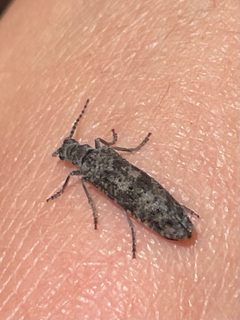
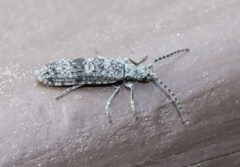
are elongated, parallel-sided beetles measuring 10–20 mm in length. Body coloration ranges from brownish to blackish or gray. The most distinctive feature is the , which bear a square pattern of transparent fenestrae or "windows" creating a reticulated appearance. The overall body form is somewhat flattened and cylindrical.
Habitat
Larvae inhabit fungus-infested dead wood and tree roots. are found in association with woody vegetation. Specific microhabitat preferences for adults are poorly documented.
Distribution
Present in Asia (East and Southeast Asia, Myanmar), Oceania (Australia, New Caledonia, New Guinea), Madagascar, East and South Africa, North America, and South America. Notably absent from Europe, though European fossil deposits are known. The distribution is relictual, with disjunct across multiple continents.
Diet
Larvae feed on fungus-infested dead wood and tree roots. are believed to subsist on pollen and plant sap, though this has not been rigorously confirmed for most .
Host Associations
- Fungi - foodLarvae consume fungi associated with decaying wood
- Dead wood - Larval development site
Life Cycle
Larvae are wood-borers that develop in fungus-infested wood. Larvae have been recorded from wood construction, suggesting they can utilize processed timber. emerge from woody substrates. Specific details of and adult longevity are not well documented.
Behavior
Males of Priacma serrata (western North America) exhibit a strong attraction to common household bleach, suggesting that chemical compounds in bleach mimic naturally occurring attractants. This has been specifically documented in this and may not apply to other cupedids.
Ecological Role
Larvae contribute to wood decomposition through their feeding activity in fungus-infested wood, potentially facilitating nutrient cycling in forest . The specific ecological impact has not been quantified.
Human Relevance
Larvae occasionally infest wood construction, where their presence in structural timber has been documented. The attraction of Priacma serrata males to bleach is a notable, if incidental, interaction with human environments. No significant economic importance has been established.
Similar Taxa
- OmmatidaeHistorically treated as a of by some authors, but distinguished by different elytral structure and, according to genomic studies, more closely related to Micromalthidae
More Details
Taxonomic history
The has been variously treated as a of or as a separate family. Genomic analyses support the separation of Ommatidae from Cupedidae, with Ommatidae more closely related to Micromalthidae.
Fossil record
has an extensive fossil record with numerous extinct dating from the Late Triassic through the Cenozoic, including specimens preserved in amber and compression fossils. This fossil diversity substantially exceeds that of the extant fauna.