
Prolixocupes
Neboiss, 1960
Species Guides
1Prolixocupes is a of reticulated beetles in the Cupedidae, suborder Archostemata. The genus contains two described with disjunct distributions: P. latreillei in central Chile and western Argentina, and P. lobiceps in western North America (Arizona, California, and Baja California, México). Archostemata is a small, relictual suborder of Coleoptera representing some of the most basal lineages.
Pronunciation
How to pronounce Prolixocupes: /proʊˌlɪksoʊˈkjuːpiːz/
These audio files are automatically generated. While they are not always 100% accurate, they are a good starting point.
Identification
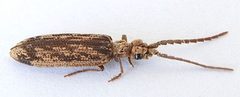
Members of Prolixocupes can be distinguished from other Cupedidae by the combination of elongated body form and specific antennal structure characteristic of the . As with other Archostemata, possess visible notopleural and a transverse occipital ridge on the . -level identification requires examination of geographic origin and subtle morphological differences; P. latreillei and P. lobiceps are and do not overlap in range.
Images
Distribution
Disjunct distribution with two . P. latreillei: to central Chile and adjacent western Argentina between 25° and 35° S. P. lobiceps: western North America including Arizona, California, and the Baja California Peninsula, México.
Similar Taxa
- Other Cupedidae generaProlixocupes shares the -level traits of reticulated beetles including net-veined and elongated prothorax, but differs in specific antennal and body proportions diagnostic of the .
- Other Archostemata familiesDistinguished from Micromalthidae, , Crowsoniellidae, and by -level characters of Cupedidae including the structure of the pretarsus and wing venation patterns.
More Details
Conservation status
Both appear to have restricted ranges; P. latreillei has a relatively narrow latitudinal band in South America, while P. lobiceps occupies arid regions of southwestern North America. No formal conservation assessments were found in available sources.
Taxonomic history
established by Neboiss in 1960. The disjunct trans-Pacific distribution pattern is notable and shared with some other relictual groups, though the biogeographic history of this pattern in Prolixocupes has not been explicitly studied in available literature.
First Mexican records
P. lobiceps was first documented from México (Baja California Peninsula) in 2012, representing the first records of both suborder Archostemata and Cupedidae for the country.