
Cupes
Fabricius, 1801
Species Guides
1- Cupes capitatus(Prominent-headed Reticulated Beetle)
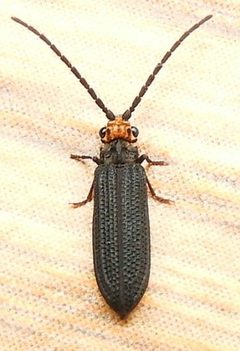
Cupes is a of reticulate beetles in the Cupedidae, containing a single extant , Cupes capitatus, native to eastern North America. The genus has a remarkably diverse fossil record, with numerous extinct species described from Eocene to Pliocene deposits in Europe and China. The extant species is small, averaging 7.8 mm in length, with distinctive orange ornamentation. The disjunct distribution—living species in North America versus abundant fossils in Europe—suggests a formerly widespread group with a contracted modern range.
Pronunciation
How to pronounce Cupes: //ˈkuː.peɪz//
These audio files are automatically generated. While they are not always 100% accurate, they are a good starting point.
Identification
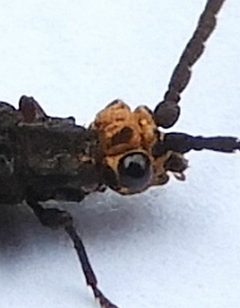
Distinguished from other Cupedidae by the combination of small size (under 10 mm), orange with prominent , and eastern North American distribution. The reticulate separate Cupedidae from all other . Within Cupedidae, Cupes can be distinguished from the related Tenomerga and other genera formerly included in Cupes sensu lato by genitalic characters and the distinctive head of C. capitatus.
Images
Appearance
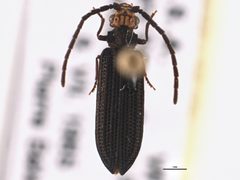
Small beetles with incompletely sclerotized that produce a characteristic reticulate (net-like) appearance. Cupes capitatus average 7.8 mm in length. Body color ranges from red to gray-brown. is bright orange with several knobby . Wings display the typical net-veined pattern diagnostic of Cupedidae.
Distribution
Extant: Eastern North America. Fossil record: Europe (especially Baltic amber of Priabonian age, Eocene deposits in Germany including Eckfelder Maar and Messel pit, Oise amber in France, Menat Formation in France) and China (Shangwan Formation). Temporal range: Paleocene (Thanetian) through Pliocene (Piacenzian) for fossil .
Similar Taxa
- TenomergaFormerly included in Cupes sensu lato; distinguished by genitalic characters and broader geographic distribution including Africa, Madagascar, Asia, Australia, and Pacific islands
- DistocupesFormerly included in Cupes sensu lato; separated based on male genitalia and distribution
- Other Cupedidae genera (Adinolepis, Ascioplaga, Rhipsideigma)All were split from Cupes sensu lato in 1984 revision based on genitalic and biogeographic patterns
More Details
Taxonomic history
The Cupes was substantially reclassified in 1984, when Cupes sensu lato was split into six genera: Cupes sensu stricto (restricted to North America), Tenomerga, Distocupes, Adinolepis, Ascioplaga, and Rhipsideigma. This revision was based on male genitalia characters and expanded the known distribution of the broader group to include Africa, Asia, Australia, and Pacific islands.
Fossil record significance
The exhibits an exceptionally rich fossil record for a small group, with over 20 described extinct . The concentration of fossils in European Eocene deposits, particularly Baltic amber, contrasts sharply with the single surviving North American species, indicating major range contraction and possible extinction across much of the former distribution.
Sources and further reading
- BugGuide
- Wikipedia
- GBIF taxonomy match
- iNaturalist taxon
- NCBI Taxonomy
- Catalogue of Life
- Reclassification of Cupes Fabricius (s.lat.), with descriptions of new genera and species (Cupedidae: Coleoptera)
- Systematics of Schinia cupes (Grote) complex: Revised status of Schinia crotchii (Hy. Edwards) (Lepidoptera: Noctuidae: Heliothinae)
- A new fossil species of the reticulated beetle genus Cupes (Coleoptera: Archostemata: Cupedidae) from Eocene Baltic amber