
Priacma serrata
(LeConte, 1861)
Priacma bleach beetle
Priacma serrata is the sole extant in the Priacma, a relict lineage of reticulated beetles in the Cupedidae. Males are strongly attracted to the odor of bleach and other chlorine-based compounds, a unique behavioral trait that facilitates collection and study. The species exhibits pronounced , with females substantially larger than males and rarely encountered. males possess non-functional digestive tracts and do not feed. display episodic mass events rather than continuous adult activity.

Pronunciation
How to pronounce Priacma serrata: //praɪˈæk.mə səˈrɑː.tə//
These audio files are automatically generated. While they are not always 100% accurate, they are a good starting point.
Identification
Distinguished from other North American Cupedidae by the combination of: lateral (rather than ) antennal insertion; four dorsal ; and male-specific attraction to chlorine/bleach odor. The lateral antennal insertion separates Priacma from all other cupedid , which possess dorsally shifted . Males are readily attracted to bleach-soaked materials, a unique among North American beetles. The larger, rarely collected females may be confused with other cupedids but share the same diagnostic head structures.
Images
Appearance
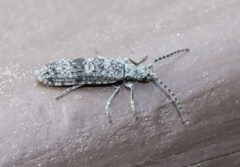
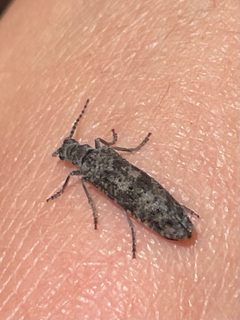
Males measure 9.6–12.5 mm in length. The body exhibits the reticulated (net-like) elytral pattern characteristic of Cupedidae. is pronounced: females are much larger than males and seldom collected. The bears four cone-shaped on the surface—a diagnostic autapomorphy of the Cupedidae. The is narrow-stalked with a round, pubescent galeomere, an likely associated with pollen-feeding. The retains a plesiomorphic shape compared to related families. The prementum is plate-like and enlarged, forming a lid that closes the mouth when retracted.
Habitat
Coniferous forests. are found under loose bark of trees. The association with coniferous forests appears consistent across the known range, though specific tree preferences are not documented.
Distribution
Western North America. Documented from British Columbia, Canada (near Lumby) and inferred to occur more broadly in western North American coniferous forests. GBIF records confirm presence in British Columbia.
Seasonality
is highly episodic, with sporadic mass emergence events rather than continuous activity. In British Columbia, males were active from early May to early June, with swarming observed on fair days during this period.
Life Cycle
Larval stages unknown. males possess withered, non-functional digestive tracts with empty intestines; dissections confirm the gut is too atrophied to pass food. This suggests adults do not feed, though the larval diet and developmental remain undocumented.
Behavior
Males exhibit gregarious and strong attraction to chlorine-based compounds, specifically bleach (sodium hypochlorite/sodium chlorate solutions). In the presence of bleach odor, males swarm and fly actively around treated materials. This behavior occurs on fair days and is sufficiently reliable to serve as a collection method. The neurological or sensory basis for this attraction is unknown. occurs in sporadic, synchronized events rather than continuously.
Human Relevance
Subject of scientific interest due to its phylogenetic position as a relict archostematan and unique male . The bleach attraction provides a rare example of a chemically-mediated, -specific behavioral response that can be exploited for monitoring or collection. No economic or pest significance documented.
Similar Taxa
- Other Cupedidae (Cupes, Tenomerga, Paracupes, etc.)Share reticulated and general body form, but possess dorsally inserted (vs. lateral in Priacma) and lack the four characteristic of Cupedidae including Priacma.
- OmmatidaeRelated archostematan with superficially similar appearance, but have vertically arranged teeth (autapomorphy of ) versus the plesiomorphic mandible shape of Cupedidae; also lack the distinctive and bleach-attraction .
More Details
Phylogenetic significance
Priacma serrata represents a relict lineage critical for understanding evolution. Cladistic analysis of places Priacma as sister to a clade containing Paracupes, Cupes, Tenomerga, and other cupedid , with the lateral antennal insertion representing the groundplan condition for the .
Research techniques
X-ray microtomography has been applied to study internal anatomy, demonstrating the utility of non-destructive imaging for morphological analysis of rare specimens. This approach revealed muscular specializations of the and pharynx not seen in other groups.
Female rarity
The extreme rarity of female collections relative to males suggests either genuinely low female abundance, different activity patterns, or preferences that reduce detection probability. The magnitude of size dimorphism and its ecological basis are unknown.
Sources and further reading
- BugGuide
- Wikipedia
- GBIF taxonomy match
- iNaturalist taxon
- NCBI Taxonomy
- Catalogue of Life
- Bembicid Holdings | Entomology Research Museum
- Grasshopper Collections and Survey
- Meloidae Holdings | Entomology Research Museum
- The Elm Zigzag Sawfly is Cute, It's Spreading Fast, and Now It Wants Your Zelkova Trees
- Back-Seat Driver: The Parasite That Makes Bees Drop Off Its Babies
- Head structures ofPriacma serrataleconte (coleptera, archostemata) inferred from X‐ray tomography
- Observations on the Flight, Wing Movements and Wing Structure of Male Priacma serrata (Lee.) (Coleoptera: Cupedidae)