
Cambala annulata
(Say, 1821)
Violet Ridged Millipede
Cambala annulata is a of in the Cambalidae, commonly known as the Violet Ridged Millipede. It is native to North America and was first described by Thomas Say in 1821. The species belongs to the order Spirostreptida, a group of large cylindrical millipedes.
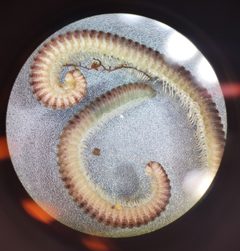
![Cambala annulata (10.3897-mycokeys.67.51811) Figure 1 by [Photo: Derek Hennen] Santamaria S, Enghoff H, Reboleira AS (2020) The first Laboulbeniales (Ascomycota, Laboulbeniomycetes) from an American millipede, discovered through social media. MycoKeys 67: 45-53. https://doi.org/10.3897/mycokeys.67.51811. Used under a CC BY 4.0 license.](https://bugswithmike.nyc3.cdn.digitaloceanspaces.com/wikipedia/arthropoda/myriapoda/diplopoda/spirostreptida/cambalidae/cambala/annulata/Cambala_annulata_%2810.3897-mycokeys.67.51811%29_Figure_1_thumbnail.jpg)
Pronunciation
How to pronounce Cambala annulata: /ˈkæm.bə.lə æn.jʊˈleɪ.tə/
These audio files are automatically generated. While they are not always 100% accurate, they are a good starting point.
Identification
Distinguished from other Cambala by specific annular (ring-like) markings or coloration patterns. The violet coloration and ridged body segments help separate it from other North American millipedes. Definitive identification requires examination of structure in males.
Images
Appearance
Cylindrical with ridged body segments. The 'Violet Ridged Millipede' suggests violet coloration and prominent longitudinal ridges (keels) along the body segments, typical of the Cambala.
Habitat
Specific details are not well documented. As a Cambalidae , it likely inhabits forest floor environments with moist soil and leaf litter, typical for large spirostreptid millipedes.
Distribution
North America. Specific range details within North America are not well documented in available sources.
Diet
, feeding on decaying plant material and leaf litter (inferred from -level traits; specific dietary studies for this are not documented).
Life Cycle
Specific details are not documented. As a diplopod, it undergoes hemianamorphic development with gradual addition of segments and legs through .
Behavior
Specific are not documented. Millipedes in this are typically slow-moving, burrowing or surface-dwelling .
Ecological Role
Contributes to decomposition and nutrient cycling in forest through consumption and processing of decaying organic matter.
Similar Taxa
- Other Cambala speciesCongeneric share cylindrical body form and ridged segments; distinguished by specific color patterns and male
- Spirostreptida millipedes in families Spirostreptidae or PseudonannolenidaeSimilar large cylindrical body form; distinguished by -level characters including segment number and structure
More Details
Taxonomic History
First described by Thomas Say in 1821, making it one of the earlier described North American . Say was a prominent early American naturalist and entomologist.
Data Availability
This appears to be under-documented in modern scientific literature. The 196 observations on iNaturalist suggest it is encountered with some frequency, but detailed biological studies are lacking.
Sources and further reading
- BugGuide
- Wikipedia
- GBIF taxonomy match
- iNaturalist taxon
- NCBI Taxonomy
- Catalogue of Life
- Lepidoptera | Beetles In The Bush | Page 10
- Quiz Yourself: 2020 Entomology Games Questions
- May | 2010 | Beetles In The Bush | Page 2
- predator avoidance | Beetles In The Bush | Page 7
- warning coloration | Beetles In The Bush | Page 2