
Sigmoria nantahalae
Hoffman, 1958
Nantahala Cherry Millipede
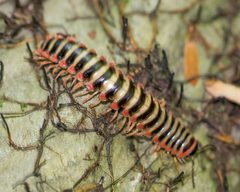
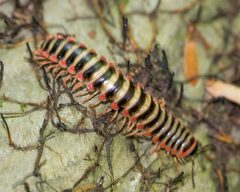
Sigmoria nantahalae is a of flat-backed millipede in the Xystodesmidae, first described by Hoffman in 1958. It is to the southern Appalachian Mountains of North America, with confirmed records from North Carolina. The species belongs to the tribe Apheloriini, a group known for producing hydrogen cyanide as a defensive secretion.
Pronunciation
How to pronounce Sigmoria nantahalae: /sɪɡˈmɔːriə næntəˈheɪli/
These audio files are automatically generated. While they are not always 100% accurate, they are a good starting point.
Identification
As a member of Xystodesmidae, this exhibits the 's characteristic flattened body form with lateral extensions (paranota) on each body segment. Specific diagnostic features distinguishing it from are not documented in available sources. The species name 'nantahalae' refers to the Nantahala region of North Carolina, suggesting geographic restriction may aid identification.
Images
Distribution
Confirmed present in North Carolina, United States. GBIF records indicate presence in North America broadly, with specific locality data pointing to the southern Appalachian Mountains.
Ecological Role
As a diplopod , it contributes to decomposition processes through feeding on decaying plant material, thereby facilitating nutrient cycling in forest .
Similar Taxa
- Other Sigmoria species share the flattened body plan and tribe-level characteristics; precise differentiation requires examination of and other fine structural details.
- Other Apheloriini genera (e.g., Apheloria, Cherokia)Members of the same tribe produce similar defensive secretions and share general body form; geographic range and specific morphological characters separate them.
More Details
Taxonomic placement
The is classified in the tribe Apheloriini within the Rhysodesminae, a group characterized by elaborate male and chemical defense capabilities.
Observation frequency
iNaturalist records indicate 277 observations, suggesting the is moderately well-documented by naturalists, though this may reflect observer effort in its restricted range rather than abundance.