
Gosodesmus claremontus
Chamberlin, 1922
Pink Feather Boa Millipede
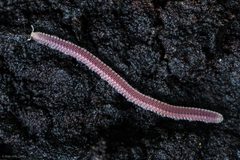
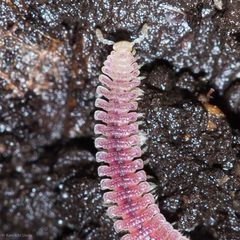
A small, brightly colored to California, notable for its pink to coral coloration and flattened body form. Body length ranges from 17 to 27 mm with up to 81 segments. Described by Ralph V. Chamberlin in 1922, it is among the most frequently observed millipedes in California on citizen science platforms.
Pronunciation
How to pronounce Gosodesmus claremontus: //ɡoʊsoʊˈdɛsməs ˌklæriˈmɒntəs//
These audio files are automatically generated. While they are not always 100% accurate, they are a good starting point.
Identification
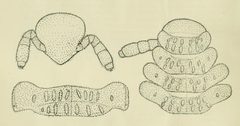
Distinguished from other California millipedes by combination of: (1) flattened, ribbon-like body shape characteristic of order Platydesmida; (2) pink to coral coloration; (3) small size under 30 mm; (4) high segment count (up to 81). Similar pink-colored millipedes in Xystodesmidae (e.g., Harpaphe, Boraria) have cylindrical bodies and differ in segment number and paranotal structure. Other platydesmids in California (if present) would require examination of for definitive separation.
Images
Appearance
Flattened, ribbon-like body with variable pink to coral base coloration. Some individuals display a black or purple stripe running the length of the body. Body length 17–27 mm with up to 81 segments. The platydesmidan body form is distinctly broad and low compared to cylindrical millipedes.
Habitat
Occurs in mesic forest environments including coastal redwood forests, mixed evergreen woodlands, and montane coniferous forests. Found in the Coast Ranges and Sierra Nevada. Specific microhabitat preferences include decaying wood, leaf litter, and moist soil layers. Elevation range spans from near sea level to montane zones.
Distribution
to California, United States. Documented from the Coast Ranges (including northern and central coastal counties) and the Sierra Nevada. Absent from desert regions and the Central Valley.
Seasonality
Activity patterns poorly documented; observations span multiple months suggesting year-round presence in suitable microhabitats. Surface activity likely increases during moist conditions following rainfall.
Behavior
Slow-moving, burrowing typically found in decaying woody debris and moist soil. When disturbed, exhibits coiling typical of many millipedes. No defensive secretions documented for this , though related platydesmids are not known to produce benzoquinones characteristic of many other millipede orders.
Ecological Role
Contributes to decomposition of woody plant material and nutrient cycling in forest . Serves as prey for small vertebrates and in forest floor .
Human Relevance
Frequently photographed and shared on citizen science platforms due to striking coloration; among the most recognizable California millipedes for naturalists. No documented economic importance or pest status.
Similar Taxa
- Harpaphe haydeniana (Yellow-spotted Millipede)Overlaps in California coastal forests and shares bright aposematic coloration, but has cylindrical body, larger size (up to 60 mm), and distinct yellow spots on black background rather than uniform pink.
- Boraria strictaSimilar pink coloration and California distribution, but cylindrical xystodesmid body form, larger size, and different segment/paranotal structure.
- Other PlatydesmidaShare flattened body form but require examination of male or detailed segment counts for definitive identification; geographic separation may apply for non-California .
More Details
Taxonomic History
Described by Ralph V. Chamberlin in 1922 based on specimens from Claremont, California (type locality). The Gosodesmus remains , with G. claremontus as the sole described .
Observation Bias
High visibility on iNaturalist (795+ observations) reflects both genuine abundance in suitable and observer attraction to its conspicuous coloration; actual status unassessed.