
Brachycentridae
Ulmer, 1903
Humpless Casemaker Caddisflies
Genus Guides
4- Adicrophleps
- Amiocentrus(humpless casemaker caddisflies)
- Brachycentrus(Grannom Caddisflies)
- Micrasema(humpless casemaker caddisflies)
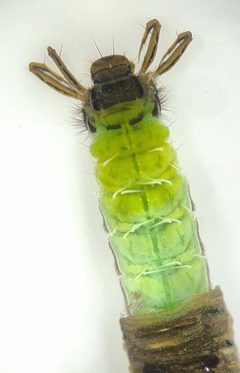
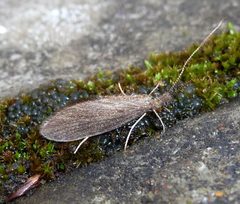
is a of caddisflies (order Trichoptera) commonly known as humpless casemaker caddisflies. The family contains approximately 100 across 8 and is distributed across North America, Europe, and Asia. Larvae construct portable cases using plant material, rock fragments, or silk, with some species exhibiting specialized filter-feeding . The family was first described by Georg Ulmer in 1903 as a of Sericostomatidae before being elevated to family rank.
Pronunciation
How to pronounce Brachycentridae: //ˌbrækəˈsɛntrɪdiː//
These audio files are automatically generated. While they are not always 100% accurate, they are a good starting point.
Identification
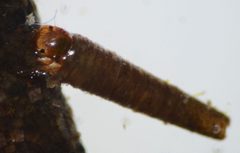
Larvae can be distinguished from other caddisfly by case construction materials and form: cases are typically cylindrical and made of plant pieces, stones, or silk, lacking the pronounced humps found in some related families. The presence of lateral humps on the first abdominal segment in Tsudaea is diagnostic for that . require examination of genitalia and wing venation for precise identification; dichotomous keys are available for North American and Japanese .
Images
Habitat
Larvae inhabit lotic freshwater environments including trout streams and lowland rivers. They occupy benthic , typically attaching to coarse substrates. Some occur near the Arctic Circle (Adicrophleps, Amiocentrus). High suspended sediment loads and substrate embeddedness negatively impact .
Distribution
North America, Europe, and Asia. Specific regional distributions include: southeastern Siberia and Japan (Doliocentrus), western North America (Eobrachycentrus), Arctic Circle regions (Adicrophleps, Amiocentrus), and Japan (Tsudaea, Eobrachycentrus).
Diet
Larvae exhibit diverse feeding strategies: most are collector-gatherers or grazers; some Brachycentrus are filter-feeders, capturing suspended organic particles from water using hair-fringed cases or nets. Micrasema quadriloba has been observed grazing on periphyton.
Life Cycle
Complete with , larval, pupal, and stages. Larval development includes case construction and growth through multiple instars. Specific timing varies by and region; Brachycentrus subnubilus has been studied in Central Poland lowland rivers.
Behavior
Larvae construct and inhabit portable cases throughout development. Filter-feeding position themselves to maximize water flow through capture structures. Larvae alter feeding positions and movements in response to high flow conditions. Laboratory studies show reduced feeding activity and altered positioning under high turbidity (500 NTU) compared to low turbidity (50 NTU or lower).
Ecological Role
Larvae function as important primary consumers in aquatic , processing detritus, periphyton, and suspended organic matter. They serve as significant prey for trout and other fish . Filter-feeding species contribute to nutrient cycling and energy transfer in stream . densities and secondary production are sensitive indicators of stream sedimentation and quality.
Human Relevance
Used as bioindicators of stream health and water quality, particularly regarding suspended sediment impacts. Sensitive to degradation from sedimentation, making them valuable for environmental monitoring. Important component of trout stream supporting sport fisheries.
Similar Taxa
- SericostomatidaeHistorically related; was originally described as a of Sericostomatidae. Distinguished by larval case construction and absence of certain morphological characters.
- HydropsychidaeBoth contain filter-feeding larvae. Hydropsychidae construct fixed retreats with capture nets rather than portable cases, and possess different larval including gill structures.
- LimnephilidaeBoth are case-making caddisfly . Limnephilidae typically construct cases from larger plant fragments and often have broader ecological tolerances; larval identification requires examination of capsule and thoracic patterns.
More Details
Taxonomic History
First described by Georg Ulmer in Germany in 1903 as a of Sericostomatidae, later elevated to rank. The type is Brachycentrus J. Curtis, 1834.
Genera
Eight recognized : Adicrophleps, Amiocentrus, Baissoplectrum, Brachycentrus, Dolichocentrus, Eobrachycentrus, Hummeliella, and Micrasema. Tsudaea was erected in 2009 for a Japanese previously assigned to Eobrachycentrus.
Conservation Concerns
are vulnerable to suspended sediment pollution from agricultural , construction, and other land-use activities. High turbidity reduces feeding , alters , and can lead to population declines, reduced growth rates, and lowered secondary production.
Sources and further reading
- BugGuide
- Wikipedia
- GBIF taxonomy match
- iNaturalist taxon
- NCBI Taxonomy
- Catalogue of Life
- Tsudaea, a new genus of Brachycentridae (Trichoptera) from Japan
- REVISION DES TRICHOPTèRES CANADIENS : III. Les Hyalopsychidae, Psychomyiidae, Goeridae, Brachycentridae, Sericostomatidae, Helicopsychidae, Beraeidae, Odontoceridae, Calamoceratidae et Molannidae
- Effects of Suspended Sediments on the Population Dynamics and Behavior of Filter-Feeding Brachycentrus occidentalis (Trichoptera: Brachycentridae) Larvae in a Southeastern Minnesota, USA, Trout Stream
- <p class="HeadingRunIn"><strong>The genus <em>Eobrachycentrus</em> Wiggins (Trichoptera, Brachycentridae) in Japan</strong></p>
- Density, production and life cycle of Brachycentrus subnubilus Curtis (Trichoptera: Brachycentridae) in a lowland river, Central Poland
- Potential Influence of Suspended Sediments on the Population Dynamics and Behavior of Filter-Feeding Brachycentrus occidentalis (Trichoptera: Brachycentridae) Larvae in a Southeastern Minnesota, USA, Trout Stream
- Reach-Scale Distribution Dynamics of a Grazing Stream Insect, Micrasema quadriloba Martynov (Brachycentridae, Trichoptera), in Relation to Current Velocity and Periphyton Abundance