
Amiocentrus
Ross, 1938
humpless casemaker caddisflies
Species Guides
1- Amiocentrus aspilus(humpless casemaker caddisfly)
Amiocentrus is a of caddisflies (order Trichoptera) in the Brachycentridae, commonly referred to as humpless casemaker caddisflies. The genus was established by Ross in 1938 and contains at least two described : Amiocentrus aspilus and Amiocentrus tessellatum. Members of this genus are aquatic insects whose larvae construct portable cases from plant material.
Pronunciation
How to pronounce Amiocentrus: /ˌæmioʊˈsɛntrəs/
These audio files are automatically generated. While they are not always 100% accurate, they are a good starting point.
Identification
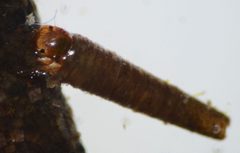
in this lack the pronounced humps on the that characterize some related Brachycentridae genera, hence the 'humpless casemakers.' Larvae construct tapered, cylindrical cases from plant material arranged in spiral or circular patterns. Specific identification to level requires examination of genitalia and wing venation patterns.
Images
Habitat
Aquatic environments, specifically freshwater streams and rivers. Larvae are found in running water where they attach their cases to submerged substrates.
Distribution
North America. The has been documented in the United States, with records from various regions including the eastern and western states.
Life Cycle
Complete with aquatic larval and pupal stages. Larvae are case-bearing and live in freshwater . are terrestrial and short-lived, functioning primarily for .
Behavior
Larvae are filter-feeders or grazers that remain within their constructed cases, which they attach to rocks or other submerged surfaces in flowing water. Cases provide protection and camouflage.
Ecological Role
Larvae contribute to nutrient cycling in freshwater through their feeding activities on periphyton and detritus. They serve as prey for fish and other aquatic .
Human Relevance
Larvae are occasionally used as indicators of water quality in biomonitoring programs due to their sensitivity to conditions. may be encountered by anglers as they sometimes emerge near trout streams.
Similar Taxa
- BrachycentrusAlso in Brachycentridae, but Brachycentrus have a distinct hump on the of and larvae construct square or rectangular cases from plant material arranged in transverse rows rather than spiral patterns.
More Details
Etymology
The name Amiocentrus derives from Greek roots, with 'amio-' suggesting 'without' or 'lacking' in reference to the absence of the hump characteristic of related genera.
Taxonomic history
Established by Herbert H. Ross in 1938, this was separated from Brachycentrus based on , particularly the flattened or slightly convex rather than the pronounced hump seen in Brachycentrus.