
Brachycentrus
Curtis, 1834
Grannom Caddisflies, Humpless Casemaker Caddisflies
Species Guides
6- Brachycentrus americanus(American Grammon)
- Brachycentrus appalachia(Apple Caddis)
- Brachycentrus incanus
- Brachycentrus lateralis(humbles casemaker caddisfly)
- Brachycentrus numerosus(humbless casemaker caddisfly)
- Brachycentrus occidentalis(humpless casemaker caddisfly)
Brachycentrus is a of in the Brachycentridae, commonly known as grannoms or humpless casemaker caddisflies. The genus contains at least 30 described distributed across North America and Eurasia. Larvae are aquatic filter-feeders that construct portable cases from silk and environmental materials such as sand, small stones, or plant fragments. The genus is ecologically significant as an important prey item for trout and other freshwater fish.
Pronunciation
How to pronounce Brachycentrus: /bræˈkɪsɛntrəs/
These audio files are automatically generated. While they are not always 100% accurate, they are a good starting point.
Identification
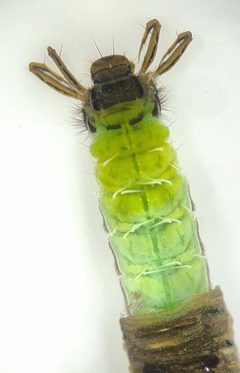
Larvae construct distinctive cases using silk to bind together sand grains, small stones, or plant material. Cases are typically cylindrical and portable, unlike the fixed retreats of some other caddisfly . lack the pronounced humps on the seen in related families, giving the "humpless casemakers." -level identification requires examination of adult genitalia or detailed larval .
Images
Habitat
Larvae inhabit running freshwater environments including streams and rivers. They attach their cases to coarse substrates such as rocks and woody debris in flowing water. Optimal conditions include moderate flow velocities and coarse bottom substrates; high levels of suspended sediments and fine substrate embeddedness reduce suitability.
Distribution
Recorded from North America (including Vermont and other US states), Europe (Denmark, Norway, Sweden), and Central Asia. Specific distributions vary: Brachycentrus americanus occurs in Wisconsin and Montana; Brachycentrus occidentalis in Minnesota, Wisconsin, and Montana; Brachycentrus subnubilus in Central Poland, Austria, and England.
Seasonality
Activity patterns vary by and latitude. Brachycentrus occidentalis larvae appear in mid to late summer, pupate in late April through May, and emerge after peak in mid-June. Brachycentrus americanus larvae appear in autumn, overwinter as early instars, and adults emerge in late August and early September. Larval growth occurs primarily during autumn, spring, and late summer, with reduced activity during winter and spring freshet periods.
Diet
Larvae are filter-feeders that capture organic seston from the water column. They have been observed filtering at night more frequently than during the day.
Life Cycle
Aquatic larvae progress through five instars before . Pupation occurs within the larval case, which is sealed and attached to substrate. Males and females show differences in case size and pupal duration: male cases are approximately 3 mm shorter than female cases, and pupal duration is 34.5 days for males versus 31.0 days for females at 10°C. are terrestrial and short-lived.
Behavior
Larvae exhibit diel periodicity in , with almost 100% filtering at night versus approximately 60% during the day. Daytime behaviors include case building, remaining withdrawn in attached cases, and crawling when unattached. Larvae may graze on substrate when unattached. of pupae has been documented, with females attempting cannibalism more frequently and successfully than males. Pupae are also subject to by (Eukieffefriella sp.). Exposure to esfenvalerate induces case-abandonment and reduces case-building ability.
Ecological Role
Important component of stream macroinvertebrate and significant prey for trout. Filter-feeding activity contributes to organic matter processing in lotic . Serves as a bioindicator of stream health, with and secondary production reduced by degradation from suspended sediments.
Human Relevance
Used as a model organism in freshwater and ecotoxicology research. Sensitive to water pollution and degradation, particularly from suspended sediments and . Trout anglers recognize patterns.
Sources and further reading
- BugGuide
- Wikipedia
- GBIF taxonomy match
- iNaturalist taxon
- NCBI Taxonomy
- Catalogue of Life
- Behavior of Larval Caddisflies (Brachycentrus spp.) as Influenced by Marking
- Behavioral Ecology of Brachycentrus Occidentalis Banks during the Pupation Period
- Diel periodicity in the behaviour of the caddisfly, Brachycentrus americanus (Banks)
- Characterization of the Hydraulic Habitat of Brachycentrus occidentalis, a Filter-Feeding Caddisfly
- The biology of Brachycentrus subnubilus Curtis (Trichoptera) in the River Frome, Dorset
- Esfenvalerate-induced case-abandonment in the larvae of the caddisfly (Brachycentrus americanus)
- A quantitative description of the life cycle and density regulation of Brachycentrus subnubilus in the Austrian Danube
- Density, production and life cycle of Brachycentrus subnubilus Curtis (Trichoptera: Brachycentridae) in a lowland river, Central Poland
- Effects of Suspended Sediments on the Population Dynamics and Behavior of Filter-Feeding Brachycentrus occidentalis (Trichoptera: Brachycentridae) Larvae in a Southeastern Minnesota, USA, Trout Stream
- Ecology and coexistence of two species of Brachycentrus (Trichoptera) in a Rocky Mountain river
- Reanalysis of Filter-Feeding Behavior of Caddis Fly (Brachycentrus) Larvae Reveals Masking and Circadian Rhythmicity
- Potential Influence of Suspended Sediments on the Population Dynamics and Behavior of Filter-Feeding Brachycentrus occidentalis (Trichoptera: Brachycentridae) Larvae in a Southeastern Minnesota, USA, Trout Stream
- First biochemical and behavioural analysis of the response of the scorpion Urophonius brachycentrus (Thorell: 1876) upon exposure to an organophosphate